
 Meet Joseph Holt, a lawyer educated in Bardstown, Kentucky, who moved into the upper echelons of power under President James Buchanan, along with fellow Democrat, Edwin Stanton.
Holt was Secretary of War under Buchanan, a position Stanton would hold under Lincoln. War, it should be noted, is the greatest profit producer known to man, and Secretary of War is the key man deciding who profits most.
Recently, I watched Robert Redford’s The Conspirator, a film that reveals how Mary Surratt was railroaded onto the gallows by a kangaroo court after Lincoln’s assassination. The film encouraged me to peer deeper into the case, and I’ve been astounded by what I’ve uncovered in one week assembling primary documents available free online. Thanks to hundreds of citizen researchers, this case is probably the most heavily documented murder trial in history. In the late 1930s, a professor in Chicago published a book suggesting Stanton was involved in the assassination, and marshaled considerable evidence to support this claim, some of which has been disputed. But after watching Redford’s film, I became sympathetic to this theory, because it certainly was a kangaroo court.
Little known today is the fact public sentiment turned against Stanton and his tribunal after its key witness, Sandford Conover, was unveiled as a chronic perjurer. In fact, much of the eyewitness testimony at the trial appears manufactured and the chief investigator, Lafayette Baker, was notorious for manufacturing evidence and accepting bribes, while his boss Stanton had become quite expert at arranging convictions.
Conover was eventually unmasked as Charles Durham, a New York lawyer and double or possible triple agent who had been posted inside the Confederate War Department briefly and had posed as a journalist writing simultaneously for both sides. Historians are still trying to unravel all the various identities he created during the war.
Forgotten today is the fact Jefferson Davis and the heads of the Confederate Secret Service were proclaimed guilty of fomenting the assassination by President Andrew Johnson before the trial commenced. In response, they accused Johnson as being the instigator, as Johnson seems to have benefited most, and Booth had left his calling card at Johnson’s hotel before the assassination, a detail that convinced Mary Todd Lincoln of Johnson’s guilt. That theory conflicts with the allegation Johnson was slated for assassination along with Secretary of State Seward that night. Although the military tribunal sold that story to the nation, there remains zero evidence anyone ever intended to assassinate the Vice President.
Check out the trial transcript and I think you’ll be amazed at the obvious manipulations. The first third of the trial involved crimes fomented by Davis and the Confederate Secret Service located in Canada, and had nothing to do with the people on trial. Those poor saps were all fringe characters who had the misfortune of knowing John Wilkes Booth and being Southern sympathizers. Booth was dead, so there was little hope of moving up the chain to discover who financed the complex operation, and Booth was discovered with a large amount of cash. And Booth’s acquaintances were held in solitary confinement with hoods permanently placed over the heads so anything they might have known wasn’t going to leak out.
But once Conover was unmasked as a serial liar, the credibility of Holt’s military tribunal was put in doubt, and the fact neither Jefferson nor any Confederate officials were put on trial only supported the conclusion the trial had been rigged to hang patsies so real criminals could walk free.
Secret societies were very popular during the Civil War. Some, like the Knights of the Golden Circle, were masonic spin-offs possibly created by high-ranking masons who wanted to launch operations without casting shadows on their primary lodges. Albert Pike was the most powerful mason in America at the time, and although he was from Boston, Pike became a Confederate General and organized Indian raids on civilians during the war.
One powerful secret society was located in New York City, the Order of the Star Spangled Banner, created to protest the arrival of Irish, Italian and German immigrants into North America, especially Catholics. This movement become national and launched the powerful “Know Nothing” political party, so named because of the response members were instructed to give when questioned about the society. Thaddeus Stevens became an important member of that society.
Many conspiracy theories were floated right after the assassination, possibly by Stanton himself as he controlled the press in Washington. The official story was that Jefferson Davis had masterminded the plot in revenge for losing the war, but many were led to believe it was a Catholic conspiracy based on John Surratt and his mother being Catholic. Many intelligent Americans, however, probably suspected Stanton, since he was cited as the most unpopular man in the country by some newspapers. This theory would not re-emerge until the late 1930s.
After the hanging of Mary Surratt, the country was left with a sour taste since she was the first woman executed in American history and now it looked like she was set-up and innocent of all charges.
Holt became so dishonored by public sentiment he eventually published a pamphlet to clear his name in which he accused Jefferson Davis of fomenting a campaign to destroy his credibility by planting the spy Conover in his case. That document is available here:
https://archive.org/details/vindicationofju3693holt
Later on, Holt would write another book about the assassination, but this one accused the Vatican of fomenting the plot.
 You don’t read much about Jacob Thompson these days, but during the Civil War he was in charge of the Confederate Secret Service in Canada. Thompson had been Secretary of the Interior prior to the South’s succession.
 On October 19, 1864, Thompson sent 21 Confederate cavalrymen dressed in civilian clothes to hold up three banks in St. Albans, Vermont. The soldiers escaped into Canada with $208,000. During the robberies, bank workers were forced to swear allegiance to the Confederacy before opening the vaults, a scene captured in the newspaper lithograph below. The raid backfired, however, since most Canadians resented the use of their country to launch raids. Around $88,000 was recovered and returned to the banks, although Canada refused to extradite the 21 men involved. Immediately after the raid, Dunham appeared in Canada in a failed attempt to penetrate this conspiracy, but was eventually unmasked by the Confederate community in Canada.
 Since most historians support Secretary of War Edwin Stanton’s military tribunal, most of what you read about the Lincoln assassination follows his carefully constructed script, however bogus that appears today.
 Gideon Welles (left) was the Secretary of the Navy during the Civil War and after he retired from politics, he published a diary, and here’s what Welles had to say on the subject of Stanton:
 President Lincoln’s death was the first successful presidential assassination in United States history and as such deserves attention because many of the details mirror those found in later assassinations. The biggest missing piece from the officially sanctioned history are the names of the secret societies that manipulated events behind the scenes and the political operatives they often employed. If you saw Steven Spielberg’s Lincoln, you saw that passage of the 13th Amendment was left to some professional political fixers who traded patronage jobs for votes.
 John Wilkes Booth was an intelligence operative and possible member of a devious Southern rights secret society called the Knights of the Golden Circle, which had thousands of members sprinkled throughout the north. The network was uncovered by a Union War Department investigation shortly after the Civil War broke out and could have been set-up in anticipation of the war.
 The most likely candidate as Grand Poobah of the Lincoln hit would be Jay Gould, who made more money on Wall Street during the war than anyone else.
 Lafayette Curry Baker deserves a larger place in the history books because he played a key role in the Great Lincoln Conspiracy. Baker was considered one of the most corrupt and ruthless officials in Washington D.C., and owed all his power and prestige to Secretary of War Edwin M. Stanton.

 I tinkered around conducting my own deep political research for years, but it wasn’t until I began the study of secret societies that I made any real headway. My big breakthrough was exploring connections between the Sicilian men-of-honor society and the Central Intelligence Agency, two secret societies that plotted to assassinate Fidel Castro. But after JFK called off that murder, the same team assembled to kill Castro ended up killing Kennedy. If Congress ever holds a real investigation, this is the reality that will emerge, although I suppose the instigators will be long dead by then.
 Check out Surratt (left) wearing his Papal Zouave uniform. Surratt was such a devoted Catholic he volunteered to defend the Papal States during the final years of their existence. Eighteen months after his mother was hung, however, he was spotted in Egypt and escorted back to America to stand trial still wearing his Papal Zouave uniform. Fortunately for Surratt, a law had just been passed forbidding military courts from trying civilians so the government was unable to secure his conviction, although Surratt freely admitted associations with Booth, he claimed no part of the murder and most of the jury believed him.
 While researching this blog, I uncovered a scientist and amateur historian who blew the whistle on Stanton back in the 1930s and Otto Eisenschiml’s groundbreaking book, Why Was Lincoln Murdered, can be read online for free here:
 The Knights of the Golden Circle was a notorious pseudo-masonic secret society you may have never heard of. In 1861, a history of the K.G.C. was published stating the Southern Rights movement began in 1834, although the first charter for a K.G.C. “castle” (their name for a lodge) was in 1854. I suggest watching The Conspirator, a film produced by Robert Redford a few years ago. I much prefer it to Steven Spielberg’s Lincoln.
 Obviously, Lincoln’s assassination was a conspiracy, and Captain John Wilkes Booth of the Confederate Secret Service had been working with Col. John S. Mosby on a plot to kidnap Lincoln and hold him for ransom. But the kidnap plot was penetrated by Louis Weichmann, and then Booth was lured to New York City, where someone pitched him the assassination. Links to New York City, however, were never investigated by the tribunal. Instead, some innocents, including Mary Surratt, were railroaded into a military courtroom and quickly hanged, something that never could have transpired had they been afforded a regular trial and effective counsel. You have to wonder why Stanton was so eager to close the case with a fabricated trial stuffed with perjuries, and after some of his hoodwinks were unmasked, Stanton refused to vacate his office where the official records were stored. Stanton, it should also be noted, was a devoted Freemason, and his political connections ran wide and deep. Ben Wade and Thaddeus Stevens were his biggest supporters in Congress.
 Stanton got his job as Secretary of War in 1862, one year after the war’s start because the previous secretary had just been sacked thanks to implementing a ruthless strategy that had initially been suggested by Stanton. Lincoln was unaware of that fact, and probably felt having a Democrat as Secretary of War provided some strategic advantage. Mostly, Stanton had the backing of the leaders of both houses of Congress, as well as a reputation as the best lawyer in the country.
 I find it fascinating Stanton got his start with a $500 loan from Clement Vallandigham (left), who would go on to become leader of the pro-slavery “Copperhead” Democrats, so named by Republicans to sheep-dip them as venomous snakes. However, before the Civil War got started, the K.G.C. was collecting funds for an invasion of Mexico (similar to the plans of British spook Aaron Burr, who’d been arrested and tried for fomenting a similar plot).
 What passes for a “free press” these days in America is pretty sad. Recently Ron Paul incurred the displeasure of the Washington Post website Daily Beast by suggesting there might be more to 9/11 than the official story. For this insult to the accepted dogmas of the state propaganda machines Paul was branded a “truther.”
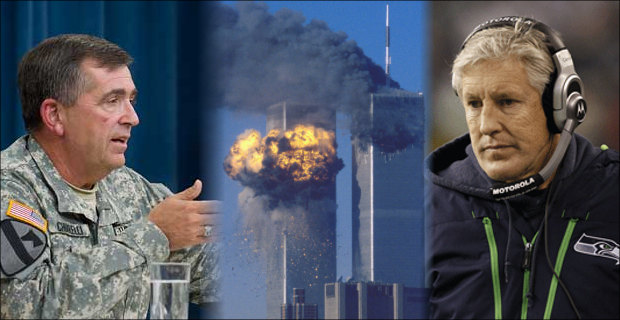
 All this despite the fact we supposedly killed the primary suspect in his bedroom in front of his family and then dumped his corpse into the ocean. If the police ever gave you a story like that would you buy it? Bin Laden’s family was put into immediate seclusion and moved back to Saudi Arabia, while most of the Navy Seals who supposedly assassinated him mysteriously died shortly after that assassination. Recently the shirt worn by the assassin during the assassination was put on display at the 9/11 museum in NYC.