
 There was no central intelligence during the Civil War, just a hodgepodge of competing spook units. Every army had its own spy system, as did every city’s police force. Ciphers were an ancient spook technology, handed down in spook world for generations. Aaron Burr had been an early master of the art, trained by His Majesty’s Secret Service, but the South had no one like him and the Confederates lost the cipher war.
Tapping telegraph lines was a constant endeavor, and that meant tapping both friend and foe, because things were really complicated due to the high volume of double agents. When the war broke out, everyone had three choices: join the rebellion, join the Union, or become a spook, which meant pretending to join one side while actually joining the other. This was not rocket science and spooks were soon strategically placed throughout both power structures. Keep in mind, the Congress and Cabinet were pretty much equally divided, and people who’d worked together as friends for decades, were instantly transformed into mortal enemies.
Ability to break codes got one promoted faster than anything in spook world, and Secretary of War Edwin Stanton clearly had the best code-breakers on his side because they were constantly intercepting messages. On December 20, 1863, a ciphered telegraph message from the Confederate Secretary of Treasury to an engraver in New York City was cracked in a few hours and revealed the location of the printing press for Confederate paper money. Assistant Secretary of War Charles Dana supervised the confiscation and destruction of money and plates. The fact a New York engraver had been selected was just an indication New York was a hotbed for Democrats and Southern sympathizers, some of whom wanted to secede and join the rebellion. Cotton was North America’s biggest and most valuable export, and the price of cotton quickly rose from 10 cents a pound at the start of the war to a high of $1.89.
The South burned massive amounts of cotton in hopes of creating a cotton famine that would help force European countries into the conflict because their economies depended on cheap cotton. But Europe had been expecting supply issues, and had been stashing cotton, and would not require more cotton for years. A brisk smuggling trade developed between Nassau and Bermuda and the Confederate States. Ships arrived stuffed with cotton and departed stuffed with armaments. These voyages could reap a profit of 500 percent, so every $5 invested in raw cotton in Mississippi became $2,500 in British rifles in Virginia. There is simply no profit stream that can compete with war, which is why many on Wall Street remained so friendly with the South. War profiteering during the Civil War likely dwarfed anything made during Prohibition, which spawned a national crime organization, and although we have a decent scorecard on players in Prohibition, the Civil War profiteers remain largely uncelebrated.
Great Britain made a fortune selling armaments to the Confederates, and their rifles were vastly superior, nothing like the junk J.P. Morgan was selling the Union, although Morgan’s contracts were enforceable, his weapons were flawed and obsolete. By the end of the war Morgan and Jay Gould would rule Wall Street thanks to their successful profiteering. The difference was Morgan was an ally of the British bankers, while Gould yearned to be King Midas and tried to go up against them (and lost).
A ciphered message was discovered in a trunk in John Wilkes Booth’s hotel room after the assassination, and it matched the cipher being used by Jacob Thompson, head of Confederate Secret Service in Canada. But there were no messages from Thompson regarding any attempted assassination of Lincoln. Clearly, Booth was getting both money and assistance during the final weeks of his life, but it wasn’t coming from Richmond, where the kidnapping plot had been hatched. No, someone who knew about the kidnapping plot was suddenly putting up money for a hit, and this operation was manifesting at lightning speed.
The day after the assassination, Secretary of War Stanton sent a terse message to his former chief of detectives in New York City. Lafayette C. Baker had been in charge of Stanton’s Gestapo, the National Detective Police (NDP), but had recently been demoted and moved to New York after Stanton discovered him tapping the War Department telegraph line. Baker arrived the following day and was given zero information, despite all the clues found in Booth’s hotel room and the abandoned room at the Kirkwood, not to mention the investigations of the Surratt boarding house. Somehow, Stanton had already concluded this house was a center of gravity regarding the assassination, and Mary Surratt was about to be turned into Stanton’s chief patsy. But he shared none of this information with his former chief of detectives, and only revealed the suspect was John Wilkes Booth, so go find him.
That meeting happening on Sunday. Two days later, a letter arrived at the War Department:
New York, April 14, 1865
Mr. Stanton
Dear Sir: If you want me you had better send for me.
J. Wilkes Booth
P.S. What do you say?
This was the first of several letters written in Booth’s hand that arrived at the War Department over the next week, each one postmarked further north, an obvious attempt to convince the NDP Booth had escaped into Canada. I suspect John Surratt’s mission in this plot was to seed these letters into Canada, because that’s where Surratt ended up, and the first one was undoubtedly posted the same day as the assassination, although the stamp is smudged beyond recognition.
But Baker must have suspected this letter was also Booth’s clue to a possible secret connection between himself and Stanton, and Baker would become suspicious of Stanton’s motivations and actions over the next few days. And knowing Stanton, I’m sure those feelings of distrust were shared equally, if not magnified, on his end against his employee. After the JFK assassination a similarly cryptic letter would be discovered addressed to a Mr. Hunt and written in the hand of Lee Harvey Oswald. For years, many assumed it was a reference to CIA officer E. Howard Hunt, although late suspicion fell more toward the benefactor of the John Birch Society, H.L. Hunt.
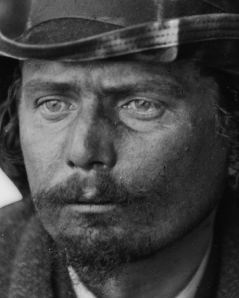
 John Wilkes Booth (Captain, Confederate Secret Service) may have had a superior officer in Washington DC at the time of President Abraham Lincoln’s assassination, and that man was 37-year-old Major Benjamin Franklin Ficklin. Why has Ficklin been excluded from almost every history book when he obviously deserves a proper place in history? He looks the part of a prosperous Southern planter, and was a great spook and adventurer much of his life, and described as a “refined pirate.”
 After being caught up in the dragnet, Ficklin admitted to owning a small stake in the Coquette, a 200-horsepower iron steamer, schooner-rigged with three masts. She could stuff over 1,200 bales of cotton in her hold and had been purchased from the Rebel Navy Department. The Coquette ran cotton one way and war munitions the other. In truth, Ficklin owned and operated two other blockade runners, the Virginia and Giraffe, all of which were captained by Confederate naval officers.
 I only add this to show the size of graft involved during the Civil War and immense fortunes realized by those who could dance through raindrops and make deals at the highest levels. Since the retired General had been a commander during the Mormon War, he and Ficklin were no doubt well acquainted, and no doubt Ficklin was the important go-between.
 Although there was the equivalent of a $2.25 million reward for the capture of John Wilkes Booth, not a single Southern sympathizer tried to collect a dime, although dozens helped Booth slip through one of the world’s greatest manhunts in history. Had he not broken his leg, Booth would have gotten away.
From the War Department records, it appears every effort was made to let Booth get away, as most of the searching was being done to the north of Washington, as if Booth had fled to Baltimore, and then on to Canada. This was the route probably taken by John Surratt a week or two earlier. Surratt had been down for a Lincoln kidnapping, but as soon as Booth’s plan shifted to murder, Surratt wisely dropped out of the venture.
To give an idea of Booth’s level of spook craft, he had a man with a crutch create a false trail for the Union cavalry to follow into the swamps, a trail that abruptly ended in the middle of nowhere, leaving those trackers wondering how a cripple on crutches could suddenly vaporize. Booth had many safe houses and accomplices willing to assist him along the route he took out of Washington. Strange none of these people were called before the military tribunal. The trial was kept narrowed down to eight minor characters, and half of those had zero to do with the plot, but were just patsies. The fewer suspects called before the court, the less chance anyone would talk, especially since patsies had nothing to reveal.
But because of the weirdness around the corpse, which disappeared several times for long periods, the door opened for fakers to claim it wasn’t Booth who was shot and killed at Garrett’s farm. Since Booth was using the name “Boyd” at the time, someone dug up a photo of a man who looked like Booth and was named Boyd and suggested he was the stand-in shot as Booth. This is absurd. If a man named Boyd had been locked in that tobacco barn, all he need do is surrender and allow himself to be taken back to Washington alive to be identified.
Afterwards, they needed someone to conclusively identify the corpse and much has been made of the fact only soldiers and a hotel clerk who barely knew Booth were officially allowed to view the body. The military doctor initially claimed he couldn’t believe it was Booth, probably because without his famous mustache and after several days travel wrapped in a horse blanket, his corpse was already starting to decay.
But this ignores the reality that Booth’s fiance was secretly brought on board the ironclad, and she’s the one who made the definitive identification by throwing herself on the corpse and sobbing. Lucy “Bessie” Hale certainly recognized the body of her one true love. She even snipped a lock of his hair, which was immediately taken from her and destroyed.
Even though Hale’s picture was found inside Booth’s diary, it would not be released to the public until the 1920s, and even then, her name was not identified. Her father was a radical Republican Senator, and held tremendous power and influence, and even though most everyone in Washington high society knew of the relations between Booth and his daughter, it would all be easily covered up. The Hale family simply relocated to Spain for four years, while the Senator took out an ad in the newspaper claiming there was no relationship between his daughter and Booth. End of story. See how easy it is to cover up truth if you can stack the deck of history? Eventually, however, the wheels fell off this hoodwink.
The best part of this story is how it reveals efforts to claim Booth escaped and lived a long and prosperous life are frauds, and there were numerous tall tales invented along these lines. So understand that any book that purports to express this view is disinfo and probably not worth reading. This is how you navigate a deep political event: once you establish where the major rabbit holes have been dug, avoiding falling into them is easy.

 Abraham Lincoln became inflated almost beyond recognition through positive mythologizing very quickly, just as his foil John Wilkes Booth received quite the opposite treatment and morphed into a cartoon character from a cheap melodrama. Forgotten is the reality Booth was the original matinee idol, receiving up to 100 love letters a day, frequently followed home to his hotel by adoring groupies, and the first person in recorded history to have his clothes shredded by fans desiring a piece of him. Not exactly the raving lunatic that’s come down in history, eh? We’ll likely never know the full list of missions Captain Booth undertook for the South, or anything close, but we do know that smuggling precious quinine was a big part of that puzzle.

 Let me be the first to admit there’s no evidence of anything unworthy or unseemly concerning Lord Richard Bikerton Pemell Lyons, 1st Viscount etc., and I don’t expect to find any, but if rumors of His Majesties Secret Service helping foment the Civil War are true, he’d be a key player in the game, having arrived two years before the outbreak of hostilities, just enough time to stoke the fires.

 “Free every slave, slay every traitor, burn every rebel mansion if these things be necessary to preserve this temple of freedom.”
 Tommy Lee Jones did a remarkable job bringing Stevens to life in Steven Spielberg’s Lincoln, ill-fitting wigs, biting wit and all. Unfortunately, that film is marred with some inaccuracies. Particularly annoying is the opening sequence in which a black soldier faithfully recites Lincoln’s Gettysburg Address, a speech that would not be discovered and made famous until after Lincoln’s death. In fact, few today comprehend the reality Lincoln was extremely controversial while he lived, and looked upon as a tyrant by many. Lincoln never captured a majority of the popular vote and was barely elected. But after the assassination he was quickly transformed into the iconic national saint we know today.


 Here’s a photo of young Robert in 1865, when he was courting John Wilkes Booth’s secret fiance and serving as captain on Ulysses S. Grant’s staff, an appointment his mother had gone to enormous lengths to prevent but ultimately failed.
 Columbia University President Nicholas Murray Butler told an interesting story in his memoirs, written after Robert’s death. He claimed that a friend had visited Robert’s estate in Vermont and witnessed the burning of much documentation. When asked what was going up in flames, Robert reportedly replied it was incriminating evidence involving a member of his father’s cabinet.
 An “honest” man in Washington D.C. is one who stays bought after being bought once, but now and then an anomaly slips through, threatening to blow the lid off the systemic corruption. Such an anomaly was Andrew Jackson Rogers, self-taught lawyer and Democratic Party member who served Congress representing New Jersey’s 4th district during the Civil War.