The immigration of Jews into the Middle East started as a trickle following the expulsion of Jews from Spain and Portugal in 1492.
Even though most of the Jews in Spain and Portugal had converted to Christianity in order to remain, the Inquisition started as a campaign to forcibly remove the Conversos, some of whom had risen to high positions running local governments and institutions. But after expelling the Conversos, the Inquisition pivoted to ethnically cleanse Europe of the Cathars who had incubated and saved the last vestiges of Manichaeism. After the Cathars were exterminated, attention shifted to recapturing Jerusalem from the Muslims.
Napoleon became the first European to suggest moving Europe’s Jews en masse to Palestine in order to ethnically cleanse Europe. Napoleon suggested this shortly after conquering Egypt. England had other plans, however, and their navy soon trapped Napoleon’s army, ending his plan of conquering Arabia. Napoleon and his staff secretly fled back to France.
The Battle of the Pyramids by François-Louis-Joseph Watteau; 21 July 1798; oil on canvas; 94.0 x 120.4 cm
The Ottoman centers of Jewish culture were in Damascus and Aleppo. Palestine became part of Syria. But after WWI, the area fell into control of the masters of spy-craft and witchcraft who reside in London. The British rule the world by playing sides against each other, manipulating with propaganda and terror ops, while peace influencers are removed by any means necessary.
This is why the modern Middle East is a British creation. After WWI, England emerged as the world’s dominant super power, a standing enforced by the world’s greatest navy, which ran on British coal. But at the close of the war it was already apparent the age of coal was ending and age of oil was commencing.
England had no oil, but could count on Dutch Royal Shell (which they had sold to the Dutch while retaining half the profits) and Standard Oil, owned by Rockefeller, a close ally. British Petroleum emerged shortly after a secret treaty was signed between England, France, Greece, Russia and Italy.
Dubbed the Sykes-Picot Agreement, it laid out how the Ottoman Empire was to be carved up after England neutralized the Sultan, which happened six years later. Key to the Sultan’s removal was inflaming Arab desire for self-rule.
Arabia should have emerged as one confederation but that would not work for the British as their geopolitical strategy involves playing sides against each other. Every successful attempt to create a democratic republic in Arabia was swiftly obliterated by outside influence, similar to the way the promising Weimar Republic in Germany was destroyed and replaced by the Nazis.
Flags used by Jordan, Palestine, Kuwait, Sudan, Syria, the United Arab Emirates, the Sahrawi Arab Democratic Republic, and Libya very closely resemble the one created by British diplomat Mark Sykes. Sykes did a study of Arab battle flags before creating his version.
Key to undermining the increasingly secularized Ottoman Empire was encouraging fanatic Muslim fundamentalism. Later on, funding Islamic revolution was the primary foil deployed to deflect Arabs from the Russian sphere of influence. Preventing the rise of an Arab super power has long been more important to US geopolitical strategy than resisting Communism.
The only way out of this mess is to slowly de-psyop the populations with real information to counter the well-funded propaganda campaigns and false flag terror events. Start here:
During the late 1980s and 90s, I had a shot at becoming famous. That was thwarted by the lawyer who stole High Times, who refused a 60 minutes request to interview me twice. I should have ignored him and let him fire me for insubordination. The excuse was he claimed I would be destroyed on the show.
The emotional abuse he heaped on me became obvious to everyone in the company as he engineered a poisonous atmosphere, where staff meetings were held with everyone but me for the purpose of finding someone to takeover whatever project I’d just initiated in order to reap the benefits without me getting any credit for the idea.
After I pitched making hemp denim jeans with my High Times phoenix logo, he rejected that idea, but soon spent millions on a hemp magazine and hemp store in Manhattan. All this bombed entirely and lost millions. One wonders how the hemp denim jeans might have faired. Thirty five years later we still don’t have them made of 100% hemp like I wanted. True denim must have a mix of white and colored threads, which is why it fades with time.
Obviously, he wanted me to depart the company, but I was an impoverished single dad with two kids trying to get by in Manhattan on a constantly dwindling salary while the company profits were booming. He tried to shut down all my events, claiming it was taking up too much time and I needed to concentrate on the magazine, which was his primary source of money. I wanted to use the events to jumpstart the High Times TV network, which is why there were 4-camera live-mix shoots at them, footage that was easily streamed to the internet.
My video content took over the website, so they scrubbed all of it. The most successful merchandise sold by the online store was stuff I’d created with the phoenix logo. He dumped it all and banned any further use of the logo, replacing it with a bland knock-off of the Time logo in red that screamed “corporate.”
I created the WHEE! festival with the help of the Merry Pranksters. They just put their toe in the first year, but went gung-ho the second, and then offered to stage WHEE3! at Mountain Girl’s farm. That meant I could easily get the Dead on board. But when I conveyed this information to Michael Kennedy he went into a rage.
I had a green light from Lion’s Gate for a million dollar film on the Cannabis Cup, using a script that detailed the Temple Dragons and my attempt to get religious rights for cannabis users. Kennedy controlled the rights and refused to let it happen. After I accused him based on the fact the producers told me what happened, he denied everything. Of course, he’d been gaslighting me for decades. But that’s when he finally broke me.
I had to remove everything regarding High Times from my apartment. It was all a trigger. I owned 10% of the company and just wanted true value, which I estimated at $2 million. I had eight shares and had set up sales of 1 share each to four people for a $250,000 or $1 million and took my kids out to dinner at a 5-star restaurant for the tasting menu. But Kennedy responded by firing me and showering me with litigation threats. There was no way he was going to allow me anything close to true value. In a few years the company was drowning in debt and sold for $40 million, but the buyer only paid half. The rest was worthless stock. So my estimate had been spot on, which is amazing for a dyslexic like me.
The good news is that even though he gave me a whopping case of PTSD, the biggest part of my healing process became researching who he really was. Turns out he was the secret leader of the terrorist Weather Underground, which was obviously part of the CIA’s Operation Chaos, which was intended to paint hippies dangerous. Aside from the Weathermen, the biggest Chaos operation was constructing Charles Manson, who was lauded as a culture hero by the phony Weathermen leaders.
I lay out the facts out on my recent song “The Ballad of the Weather Underground.” Have you got four minutes to spare?
“Psyop-Busting Ballads,” the debut album by Steven Hager, is a thought-provoking collection that dives into Hager’s most important discoveries after 50 years of investigative journalism.
Showing a mix of folk, rock, and country influences, Hager creates a sound both familiar but refreshingly innovative. Each track delves into themes of truth, manipulation, and resilience, inviting listeners to reflect on how mainstream narratives go unchallenged.
Highlights include The Ballad of Bob Dylan and The Ballad of Lee Harvey Oswald, both of which showcase Hager’s lyrical prowess. The instrumentation is tight and well-produced.
Overall, “Psyop-Busting Ballads” is not only entertaining but enlightening, serving as a wake-up call. Hager’s ability to infuse powerful messages into music makes the album a commendable addition to any discography, a must-listen for those who appreciate delving beyond official cover stories on major conspiracies.”
James Simmons was standing on the triple overpass overlooking Dealey Plaza when JFK was assassinated. Although he was interviewed by the FBI, the agents severely altered his testimony. His claim of hearing gunshots and seeing a puff of smoke or vapor on the grassy knoll was changed to fumes of a car. He was never called to testify to the Warren Commission even though he was among the most important eyewitnesses. He appeared in Mark Lane’s Rush to Judgment documentary, and also testified at Clay Shaw’s trial in New Orleans.
LANE. What did you see and what did you hear?
SIMMONS. As the presidential limousine was rounding the curve on Elm Street, there was a loud explosion. At the time I didn’t know what it was, but it sounded like a loud firecracker or a gun shot. Ann it sounded like it came form the left and in front of us towards the wooden fence. And there was a puff of smoke that came underneath of the trees on the embankment.
LANE. Where was the puff of smoke Mr Simmons in relation to the wooden fence?
SIMMONS. It was right directly in front of the wooden fence….
LANE. After you heard the shots and saw the smoke, what did you do?
SIMMONS. I was talkin with Patrolman Foster at the time. And as soon as we heard the shots we ran around to the wooden fence. And when we got there there was no one there. But there was footprints in the mud around the fence, and there was footprints on the wooden two by four railing on the fence.
LANE. Were you questioned by Dallas Police that day?
SIMMONS. Yes, I was.
LANE. Did you give your name to the Dallas Police?
SIMMONS. Yes, I did.
LANE. Did you tell them what you just told me?
SIMMONS. Yes, I did.
LANE. Were you subsequently questioned by agents of the Federal Bureau of Investigation.
SIMMONS. About a month later I was questioned by the FBI.
LANE. Did you tell them what you told me and what you told the Dallas Police?
SIMMONS. Yes, I did.
CRIMINAL DISTRICT COURT EXCERPT OF THE TESTIMONY TAKEN IN OPEN COURT
February 15, 1969
JAMES L. SIMMONS, a witness for the State, after first being duly sworn by the Minute Clerk, was examined and testified on his oath as follows:
DIRECT EXAMINATION BY MR. OSER:
Q: State your name for the record, please. State your name please.
A: James L. Simmons.
Q: Where do you live, Mr. Simmons?
A: Mesquite, Texas.
Q: During November 1963, Mr. Simmons, by whom were you employed?
A: By the Union Terminal Railway Company.
Q: Now I direct your attention to the day of November 22, 1963 and ask you if you were at work on that particular day in Dallas?
A: Yes, sir.
Q: Did you have occasion, Mr. Simmons, to go on the day of November 22 to the area commonly known as Dealey Plaza in Dallas?
A: Yes, I was in the area.
Q: Approximately noon that day in what area of Dealey Plaza were you located?
A: Standing on top the Triple Overpass.
Q: Who were you with, sir?
A: There was around ten or eleven of us there.
Q: You and some fellow employees of the Terminal Building?
A: Fellow employees.
BY MR. OSER:
Q: Now I direct your attention to State Exhibit 36 and ask you if you can locate your position on this particular diagram scene and then I ask you to place this marker, this pin in the position.
A: Yes, sir, I was standing in this position along this rail.
Q: I give you an emblem and ask you to place that in the position you were in on that particular day. You may have your seat back. Now while you were in this position, Mr. Simmons, did you have occasion to see the Presidential motorcade?
A: Yes, sir, I did.
Q: Where was the Presidential motorcade when you first saw it approaching you?
A: When I first saw it it had just turned the corner by the School Book Depository.
Q: Would that be making its turn on Elm Street?
A: Yes, sir, — no, pardon. When I first saw it it came down Main and turned by the old court house.
Q: At the time the motorcade was passing did you hear any unusual noises?
A: Yes, sir, I heard three loud reports I presumed to be shots.
Q: Where was the President’s car or limousine at the time that you heard the first shot, approximately?
A: It had, it was about one-third of the way or maybe half-way between the Depository and the Overpass.
Q: Did you have a clear unobstructed view of this scene?
A: Yes, sir.
Q: Can you tell us what reaction if any President Kennedy had to this first shot, as you saw it?
A: Well, I don’t remember exactly — it was between the first or second or thereabouts and he turned to his left and threw his hands up.
Q: At the time of the third shot that you heard can you describe what President Kennedy’s reaction was at that time as you saw it?
A: Well, he fell and there was matter and a halo of blood.
Q: Which way did he fall?
A: To his left.
Q: What did the limousine do then?
A: It paused and then accelerated real fast after the motorcycle got out the way.
Q: Did it go under the Triple Overpass?
A: Yes, sir, went directly under us.
Q: At the time you saw this red halo, what did that appear to you to be?
A: To the left side of his head.
Q: Can you tell us what direction this went in, this matter?
A: It went over the side of the car.
Q: Which side of the car?
A: The left side.
Q: Now at the time you heard the second and third shot did you notice anything unusual in the area of the grassy knoll?
A: Well, after I heard the shots I looked to see if I could see where they were coming from and underneath the trees up on the grassy knoll by the fence I detected what appeared to be a puff of smoke or wisp of smoke.
Q: From which direction did these noises appear to come from?
A: In front and the left.
Q: Were — will you step down and point out on the aerial photograph the location in which you heard the shots coming from and the area in which you saw the puff of smoke?
A: I was facing this way and the sound appeared to come from this general direction over along here, and there is a row of trees along the fence and towards the end of the fence there is a small building and just this side of it a few feet is where I saw the smoke.
Q: Will you step back, please. After having heard these shots and seeing a puff of smoke, what if anything did you do?
A: I went around — there is a fence like I say here, and I went around the railing on top the overpass and walked around behind the fence.
Q: And when you got behind the fence did you see anything unusual to you?
A: Well, I was one of the first ones there and uh, when we got there there was no one there but it had rained that morning and there were several footprints back and forth along the fence.
Q: What drew your attention to these particular footprints, Mr. Simmons?
A: Well, ’cause there were so many of them.
Q: Did you see any footprints in any other area but this area?
A: On the fence, on the fence. On the fence there was a wooden brace or rail and there were muddy footprints on it.
Q: Mr. Simmons, would you come down here and using State 36, the mockup, show the Gentlemen of the Jury and the Court, the route you took after you heard the shots and saw the puff of smoke, at approximately what area behind the picket fence you saw these footprints?
A: Yes, sir. As I stated, I was standing here and after the shots we walked around this fence and there were footprints all along behind the fence.
Q: Show us also on the aerial photograph the route you took.
A: From here around behind the fence over to the little building.
Q: Have your seat back now, sir. Mr. Simmons, while you were up on the Triple Overpass at the time of the shots, did you see any effects of any shots other than what happened?
A: I actually didn’t see any, I heard it.
Q: Did you see any effects of any shots in this area?
A: I saw the effects when it hit the President.
Q: Did you see any of the shots hit anything else in Dealey Plaza?
A: It looked as though one might have hit the pavement.
Q: Could you show us using the aerial photograph what area of the pavement you saw it hit?
MR. DYMOND: I object as he stated it “might have hit the pavement.” Counsel has asked the witness as if it did.
MR. OSER: Do you know of your own knowledge where this bullet hit?
MR. DYMOND: I object to your saying it because he said it looked as though one might have and then he was interrupted.
THE COURT: I will ask the Stenographer to read the question back.
THE REPORTER: Question: “Did you see any of the shots hit anything else in Dealey Plaza?” Answer: “It looked as though one might have hit the pavement.”
MR. DYMOND: It doesn’t say any bullet hit.
BY MR. OSER:
Q: Step down and use the aerial photograph and show us what area in Dealey Plaza you saw the effects of one of the shots appear to you to hit.
A: On the street curb in this general area (indicating).
MR. OSER: I tender the witness.
CROSS-EXAMINATION BY MR. DYMOND:
Q: Mr. Simmons, about how long after the last shot would you say you went back in the parking lot area behind the fence?
A: Immediately.
Q: Immediately, and about how long did you stay back there?
A: We were back there several minutes.
Q: Could you tell us about how many?
A: I would say 15 or 20 minutes.
Q: 15 or 20 minutes and did you see any arrests made back there?
A: No, sir, I don’t recall.
Q: Approximately how many cars were parked in that area at that time?
A: Well, it is a parking lot and it was pretty well filled with cars but I don’t know approximately how many.
Q: Do you know a person who used to be a Deputy Sheriff in Dallas, Texas by the name of Roger Craig?
A: No, sir.
MR. DYMOND: If the Court please, if Mr. Craig is in the courtroom I will ask him to stand up.
THE COURT: Stand up, Mr. Craig. Would you like to have him come forward?
MR. DYMOND: Yes.
THE COURT: Step forward, Mr. Craig.
MR. DYMOND: Come over in this general area. You may have a seat back there again.
BY MR. DYMOND:
Q: Did you see that gentleman, Mr. Simmons?
A: There were so many people back there I don’t recall his face.
Q: Did you see him or anyone else arrest a woman in the parking lot at that time?
A: No, sir, I didn’t.
Q: Did you see anybody detained by anyone that appeared to be a law enforcement officer at that time?
A: No, sir.
Q: Now, Mr. Simmons, measured in feet approximately how far were you from your point of vantage to the point where the Presidential limousine was at the time the last shot was fired?
A: I don’t know but I imagine it was two, three hundred feet.
Q: Two to three hundred feet?
A: Yes.
Q: Now, Mr. Simmons, you say that after the third shot was fired that you saw a halo of blood, is that right?
A: Yes, sir.
Q: Would you tell us just about the position of this halo of blood in relation to the President when you saw it?
A: Well, it looked like just the top of his head blew off and went up in the air.
Q: Was the halo directly over his head or to the front of him or where?
A: Like I said, it seemed to go out the left side of the car.
Q: The halo seemed to you to do that?
A: Well, the matter.
Q: Could you tell whether this halo as you described it was in front of the President?
A: Well, it seemed to be over his head.
Q: Actually you were looking straight on so it would be a little difficult for you to tell whether it was behind or in front?
A: I guess it would.
Q: Now the area behind the fence where you have described as being a place where you went you say that was a parking lot?
A: Yes, sir.
Q: Where quite a few cars were parked in it?
A: Yes, sir, there was.
Q: Was this a muddy day?
A: Yes.
Q: Was there anything unusual about there being footprints?
A: Well, there is a steam line by the parking lot and the fence and very few people have occasion to cross that steam line.
Q: Do you know whether people were up on that fence watching the Presidential parade?
A: I didn’t see anyone around there.
Q: Did you particularly look?
A: No.
Q: You were looking at the parade?
A: Yes.
Q: So there could have been people on the fence watching it and you wouldn’t notice that?
A: That is right.
Q: And that would account for mud on the rail?
A: Yes, sir.
Q: It there was mud on the rail.
A: Yes.
Q: Did you see a gentleman, I’m sure you heard of Mr. Abraham Zapruder, did you see him taking movies of the Presidential parade?
A: Well, there were people all over the area taking movies but I never seen him that I know of.
Q: Mr. Simmons, you say you saw a place where a bullet might have hit the curb and what do you base your conclusion on?
A: Well, like I say after the first shot —
Q: Yes, sir?
A: After the first shot I was screening the area to see if I could see where they were coming from and there was, it looked like dust particles fly in the air from something that had hit the curb or street.
Q: And of course you are just guessing?
A: I don’t know.
Q: Did you go over and check the curb in that area?
A: No, sir.
Q: You did not. Oh, yes, Mr. Simmons, you say that you were standing approximately here, is that right?
A: Yes, sir.
Q: And you say that the noise, that is the report from what sounded like shots came from this direction?
A: Came from in front of the sound was to the left of me.
Q: Is it not a fact that the Texas School Book Depository is in that direction also?
A: It is.
Q: Did you see anybody up on that Triple Overpass with a gun?
A: Yes, two policemen.
Q: Two policemen.
A: Yes.
Q: They didn’t fire any shots, did they?
A: No, sir.
Q: Did you hear any shots fired from the Triple Overpass?
A: No, not from there.
Q: You heard a total of what you saw is three shots?
A: Yes, sir.
MR. DYMOND: Thank you.
RE-DIRECT EXAMINATION BY MR. OSER:
Q: Mr. Simmons, you testified in front of the Warren Commission?
A: No, sir, I did not.
Q: Were you interviewed by the Federal Bureau of Investigation?
The ‘Royal Prince’ and other vessels at the Four Days Battle, 1–4 June 1666, during the second Anglo-Dutch War.
England and the Netherlands were at war. The oligarchies of both nations had pooled their resources to create immense operations to capture monopolies on trade. The Dutch had recently created the first republic in Europe, and thus drawn the intense ire of the intermingled European royal families. The purpose of the Enlightenment was to topple royalty and religion, but wouldn’t you know it, the secret agents of royalty and religion penetrated deep into the Enlightenment. The English created Freemasonry out of the ruins of the Templars, and the Jesuits created the Illuminati as a secret take-over of Freemasonry.
The Dutch had captured a virtual monopoly on tea because they were able to move it from harvest to market faster than anyone, and the fresher the tea, the more desirable it was. Meanwhile, the English East India Company had been sending all its merchant ships back to England, where tax was collected on the cargo, and then distributing the cargo to its final destination. The English sought to capture the Dutch monopoly on tea by buying an enormous amount of tea. But the Dutch had outfoxed the English and had plenty of tea to satiate the market. The East India company was on the brink of financial ruin, and had this happened, the Dutch would have won the trade war.
In order to compete, the English decided to ship tea direct to the Colonies. They put a very low price on the tea, and added a justifiable and legal tax to cover the costs of maintaining a fleet of warships to protect their merchant fleet while in transit. The tax was insignificant. But even so, they had trouble getting merchants to buy the tea because the illegal Dutch tea was preferred by smugglers who profited from the trade, and by the consumers.
What could be done? Late one night, a group of Freemasons dressed as natives emerged from the St. Andrews Lodge in Boston, boarded the East India Company ships, and tossed the tea overboard.
This was not some disaster, but actually saved the East India Company from financial ruin, as the insurance company back in London was forced to cover the loss. Even after the revolution, that insurance company had investigators and lawyers in Boston working on the case, but they never were able to unravel the truth of what had happened.
John Hancock was a smuggler and richest man in New England, although still young. He largely instigated the Revolution, and his operations flowed largely through Freemason lodges. You will notice his signature dominants the Declaration of Independence indicating his self-importance in fomenting the split.
John Hancock, tea smuggler.
By dumping all the tea, the East India Company was able to collect the full value from Lloyds of London and Hancock collected the full value of his store of Dutch tea.
Obviously, it was Hancock who dumped the tea, but his agents in Boston remained loyal and no one ever dropped a dime, although significant rewards may have been offered.
The best analysis of our revolution was provided by Charles Beard in An Economic Interpretation of the Constitution, which detailed how the biggest bond holders and bankers constructed the document to protect their interests. Most of these insiders were also Freemasons, especially the ring-leader in Virginia, George Washington.
On this date in 1859, terrorist John Brown was hanged.
Brown had taken hostages and seized an armory with the intention of sparking a slave revolt.
His terror campaign was financed by William Huntington Russell, recently graduated from Yale, who had founded a secret society called “The Order” at Yale University based on a fraternity he had joined during a summer in Bavaria. This likely would not have happened except that Phi Betta Kappa went aboveground, which greatly annoyed Russell, who was a member and valedictorian of his class. Due to the secret fraternity’s bizarre rituals involving human remains, the group soon became known as Skull & Bones.
Without Brown, there might never have been a Civil War. The rush into war was orchestrated on several fronts, but the most important was creating fear in the hearts and minds of Southern slave owners.
Strange the Russell family had benefited greatly from slavery, although their emphasis had shifted to opium after England banned slavery. The family was close with the East India Company, the world’s most powerful corporation at the time.
Aside from funding Brown’s terror campaign, Russell had also founded an officer training academy in New Haven to provide officers for the coming conflagration.
If you know there is going to be a war, you can make a lot of money by getting out in front on the profit schemes.
The possibility The Order is actually the Illuminati is very real, which would explain the deluge of tin foil hat material involving the group.
Strange a similar pattern would play out in my time. The Weather Underground launched a terror campaign against straight people. They targeted blacks either recently released from prison or returned from Vietnam, and gave them weapons and explosives, and filled their heads with Communist propaganda.
Bill Ayers, leader of the Weather Underground, after being arrested for provoking a window-smashing riot in Chicago, does not appear the least bit worried and shares a smirk similar to Brown’s.
One of their ops was the SLA that kidnapped Patti Hearst.
The Weather Underground put enough fear of hippies in the hearts and minds of middle America to keep Richard Nixon and the war continue far beyond what was necessary, resulting in the death of millions, mostly through the sideshow in Cambodia, also fomented by Communists.
Charles Manson was the major player in sheep-dipping the hippies as psychopathic serial killers.
Not only was the Civil War (which permanently divided the nation in two) an Illuminati operation, but so was the creation of Communism.
See, when you buy up all the best horses in the race, it doesn’t matter which one wins.
Brown manipulated white fear of blacks to start a war, while the Weather Underground deployed the same fears in order to keep a war going. The dialectical nature of the op is obvious if you consider John Kerry and W. Bush, who ran against each other for president, were both boners.
But the most telling detail is that after over a decade on the run while fomenting terror ops, the Weather Underground leaders came out of the cold and stepped into cushy university gigs with pensions. Not a fate that typically awaits real social revolutionaries.
Charlie was brainwashed by MK/Ultra technicians while in prison and then released into Haight-Ashbury while being monitored by a CIA-connected free health clinic. The clinic was mostly collecting data on the synthetic mind-altering drugs flooding into Haight-Ashbury, much of which was courtesy of CIA-connected underground chemists. The CIA was curious to find out how their new analogues were affecting kids, and which ones were most useful in manufacturing violence, which turned out to be speed. So speed ended up in much of the so-called LSD.
The clinic helped assemble a hippie-chick harem composed entirely of vulnerable runaways to serve Charlie, while Charlie’s probation officer, who strangely had only one parolee (Charlie), helped Charlie obtain a school bus for transporting the harem to Los Angeles, something that should have been a parole violation.
While in prison Charlie had been told to read Dale Carnegie (How to Win Friends and Influence People), Dianetics by L. Ron Hubbard and the science fiction novel Stranger in a Strange Land by Robert Heinlein. He converted to Hubbard’s Scientology religion and learned how to use an e-meter to get inside people’s deepest fears and desires so as to better manipulate them.
Dennis and Charley.
He made friends with Dennis Wilson and moved his harem into Wilson’s house. Wilson introduced him to rock producer Terry Melcher, who turned Charlie down for a record deal, pissing Charlie off immensely.
After Charlie and his sidekick Bobby B. tortured and killed Gary Hinman over a drug deal gone sour, Charlie decided to foment some copycat murders to get Bobby off the hook. He sent his crew to Melcher’s house to kill him, not realizing Melcher had moved out and the pregnant Sharon Tate moved in.
Bobby Beausoleil’s Haight-Ashbury days.
The CIA-connected Weather Underground terrorist organization immediately branded Manson a counterculture hero for the bloody and senseless Tate-LaBianca murders, a tag they also imposed on another MK/Ultra robot, Sirhan Sirhan, the patsy for the RFK assassination.
Ed Sanders and Paul Krassner investigated the murders. Krassner was invited into a bathtub with naked Squeaky Fromme but the usually randy Krassner declined and soon dropped the investigation. “You’re not afraid of me, are you?” asked the disappointed Fromme.
In 1975, Fromme came face-to-face with then-President Gerald Ford, ostensibly to discuss the plight of the California redwoods while dressed in a red robe and armed with a Colt M1911 .45-caliber semi-automatic pistol. The pistol’s magazine was loaded with four rounds, but no round was in the chamber. After Fromme produced the gun from under her robe and pulled the trigger, she was immediately restrained by Secret Service agent Larry Buendorf. While being handcuffed she mumbled on camera “it didn’t go off.” She was so poorly prepared Squeaky didn’t know how to operate the weapon. Ford’s demise would have elevated Nelson Rockefeller to the White House.
Six years later, Ronald Reagan was the target for a similar MK/Ultra-style assassination, one that would have elevated George H. W. Bush to the White House. The robot assassin was the son of an oil company executive close with the Bush family for decades, starting in Midlands, TX, favorite landing spot for rich Easterners seeking to cash in on the oil boom.
The Hinckleys were donors to various Bush political campaigns over the years and at one point, the two clans seemed to have shared the same lawyer. Neil Bush, son of the vice president, had been scheduled to have dinner with Hinckley’s brother, Scott, the day after the shooting.
Painting by the multi-talented Bobby Beausoleil
Sanders wrote a book implicating the Manson murders with a vast satanic network led by the Process Church of Final Judgment, a Scientology spinoff created in England. Soon a “Satanic Panic” infested deep state research culminating in the Tin Foil Hat Q-Anon movement.
The panic emanated initially out of the Presidio daycare center in San Francisco when four children were discovered with a sexually transmitted disease. Dozens more claimed memories of witnessing ritual ceremonies. A worker at the center (who’d previously been a Baptist minister) was convicted of lewd behavior involving ten children. The daycare center caught fire and was demolished. None of the children attendees were willing to set foot in the building, such was their trauma.
The Process and the Weather Underground used group sex with LSD to program their flock.
MK/Ultra investigations spread quickly from the Presidio to Boys Town, the most famous Catholic orphanage in America located outside Omaha, a city with the most documented cases of multiple personality disorder, as well as the highest percentage of CIA employees outside Langley, most posted to the nearby Strategic Air Command Canter, a site Bush W. flew to for refuge on 9/11.
Toddlers with no father figure (like Oswald or Manson) were considered prize targets for the mind experiments because programmers could so easily assume a father figure just by interrupting the abuse and providing some empathy. Interestingly, Manson had resided briefly in Boys Town before spending most of the rest of his life in reform school and prison, where he was always easy prey to programmers.
Process Church in Hollywood.
The satanic panic was a carefully-planned deflection away from the CIA’s MH/Chaos operations originally designed to destroy the peaceful counterculture movement by branding it as violent.
Steve Jenkins: All in all, I am of the opinion this is a great post. I do take some exception to a few things however. Manson, did get a recording contract and did produce an album. It can be heard if one puts an effort into finding it online.
While Melcher did not produce it as near as I can tell, a highly regarded group of folks played a roll, starting with the .studio where it was recorded. Several Southern California heavy hitters on the Rock scene used this very same recoding studio.
Doris Day and son Terry Melcher.
Second, one can find many instances that raise serious questions about the argument that the Manson Clan were sent to Ciello Drive to kill Melcher. Tom O’Neil spends a great deal of time on this significant detail which was a key motive used by VB during the trial of the Manson Clan. If one looks at YouTube video interviews of Tex Watson he clearly states that Manson directed him to go to Terry Melcher’s “old” house and kill everyone there.
If words mean what they say, this is an indication that both Manson and Watson knew Melcher no longer lived there at the time of the murders. This would of course back up O’Neils claim that the group was not sent there to kill Melcher in revenge for his lack of a recoding deal as claimed by VB during the trial.
As for how successful Manson’s album would or would not have been, it’s a matter of great debate. I personally have listened to a reasonable amount of Manson’s music and I am personally not a fan. Others who have achieved considerable success in the music Industry have a different view than I. The Beach Boys released a Manson song on once of their albums. They changed the name and did not credit him, but it is his song. Others have released songs by Manson as well…well known bands. The album itself was being finalized in the fall of 1969 and was not released until after Manson’s arrest. It’s difficult to calculate how much Manson’s Notoriety affected the promotion of this album.
The important stuff are his connections to CIA ops. I believe Dennis may have taken him to Terry’s to make the introduction. Whether he was targeting the house or targeting Terry doesn’t real matter in the long run.
If one really wants to understand what went on who was being targeted is pretty significant in terms of understanding. Manson is far more than two nights in early August of 1969. A focus on the murders that took place then as opposed to a bigger picture reduces the likelihood of developing an understanding of what Project Manson was really about and why it went off the rails. If one looks, one can find what might be best called the fingerprints of Intelligence dating back almost a decade before the killings at Cielo Drive.
Here’s a little detail few know about. I once tried to get an interview with Wavy about Manson. He said, “No Manson interviews.”
Wavy has been in my crosshairs for some time now. He married Bob Dylan’s first significant girlfriend. He is easily as important a subject of study as Manson.
Check out the Lyman family.
Yes, I grew up in the Boston Area. Lyman opens many windows for me. I used to regularly park my car very close to Fort Hill…the central location of the Lyman Family. Lyman intersects with Manson all over the place. Manson’s writing has appeared in Avatar, the Fort Hill publication. Linda Kasabian, key witness vs the Manson’s and who did no jail time lived at Fort Hill before moving to LA. Her husband lived at the Hog Farm at the time of the killings. The Hog Farm, the Spahn Ranch, and Fort Hill share remarkable similarities.
After becoming editor of High Times, I was able to hire writers on deep state machinations, something not being done by anyone else in the media, aside from fanzines, of which there were many. Painfully, I discovered the famous writers were digging rabbit holes. Nobody was trying to unveil the operatives inside the counterculture media. I sadly published highly dubious stories by the likes of Robert Anton Wilson, Paul Krassner, Alex Constantine and others.
Aside from that I was flooded with Tin Foil Hat submissions. My most prominent researcher was Dick Russell, a former writer to media powerhouses TV Guide and Sports Illustrated. Dick had spent years investigating the CIA regarding the JFK assassination and had scored major interviews with Angelton and other CIA bigwigs. The only other journalist to have such a relationship is Ron Rosenbaum, a leading disinfo operator who helped demolish the reputation of Danny Casolaro. Dick focussed his investigation on Richard Case Nagell, reportedly a double agent inside the Stasi who was tasked with the mission of killing Oswald. Instead, Nagell fired a round inside a bank in order to get himself put into jail.
Nagell placed under arrest shortly before JFK’s assassination.
Nagell had a lot of inside info on CIA ops and wrote highly entertaining letters. He kept people on the hook for decades anticipating some huge breakthrough that never arrived. I guess you know every year the CIA floated a new breakthrough, all of which turned out to be misdirections: KGB did it, Cuba did it, the mob did it, the driver did it, LBJ did it, etc. Nagell’s rabbit hole was called H.L. Hunt did it.
Dick did a book with Jesse Ventura. His work is meticulously well-researched and much higher caliber than Ron Rosenbaum. More recently, he made an anti-Trump website, and has appeared at JFK assassination events run by the completely quacky Judyth Vary Baker. Dick lives in the secretive Lyman compound in Los Angles. The family seems very, very wealthy.
I have been paying a great deal of attention to Dick Russell for a while now. Your input here has been very helpful as it is consistent with my current thoughts on several folks I have looked up to in the past. I admit to having been fooled more then twice. I propose a conference call with Mark Mueller and Roy Johnson and myself. We all work together. I have been researching this exact topic for the last year or so and I have widened my lense considerably including potential links to the Boston Strangler and many many other seemingly unrelated events that I now believe are related. Note how many forwards Russell has written in Kennedy assassin books….note who has published most of these. Look at how closely he has intersected with two potential national candidates…Ventura….Kennedy. Thanks again for your input…you have added to my knowledge particularly about Russell who I once really looked up to.
Can’t do conference calls or interviews. But I have put everything I know into this website, and you should check it out in detail. I could never figure out why my once-famous career got throttled, mostly by the lawyer who stole High Times, who turned out to be connected to Chip Berlet, AJ Weberman and Ron Rosenbaum. I assume they were all MH/Chaos. You might enjoy my Youtube playlist Everything You Know is Twisted. I’m basically retired and tired of jockeying with agents of disinfo, most of whom have no idea they have been led into a rabbit hole. You can’t do deep state research without being blanketed by them.
What is history but a fable agreed upon? —Napoleon Bonaparte
Major historical events, such as revolution, assassination, and war, are usually presented as random events created through chaos and chance. Should any suggest these seminal events are more likely the result of plots hatched in secret, they are quickly dismissed as conspiracy-theory crackpots. Yet anyone who studies the methods for absorbing and maintaining power understands it’s far more likely war and political assassination are the result of hidden conspiracies than random accidents involving isolated loners.
The true study of history is largely a study of secret societies. Not surprisingly, one finds little mention of these societies in history books, at least not in any school textbooks. However, a few hours on the Internet may be enough to convince one of their importance.
IN THE BEGINNING
By far the oldest and largest secret society is Freemasonry, which claims over four million members worldwide, most of whom are in the United States. Today Masonry is a fraternal group that supports many charities. Overwhelmingly, its members are decent, honest people who enjoy the theater and symbolic trappings of the organization.
The average Freemason is not an evil Satanist, as some church groups would have you believe. However, Masonry has been manipulated as an intelligence asset for centuries. The organization has a remarkable ability to create spin-off societies that claim no connection to Masonry but could be examples of freestanding, off-the-shelf operations possibly under control of high-ranking Masonic councils. Some of these spin-off organizations have undoubtedly become among the most dangerous in the world. Rudyard Kipling’s The Man Who Would Be King was made into a brilliant film by John Huston. It tells the story of two former members of the British Army, stranded in India, who decide to invade Afghanistan for the purpose of crowning themselves kings of a land not conquered since Alexander the Great. They are fully prepared to foment bribery, murder, pillage, and plunder. But they are also devout Freemasons.
The first historical record of a Masons’ guild comes from Germany. In 1080, the Steinmetzen, or stone masons, organized a craft guild with rules, ceremonies, and titles. In the Middle Ages, most craftsmen were organized into such guilds and jealously guarded the secrets of their professions.
Fifteen years later, the first (and only successful) Crusade to seize Jerusalem was launched. At the conclusion, the world’s most influential secret society was born: the Poor Fellow Soldiers of Christ and the Temple of Solomon, otherwise known as the Templars. Only men 21 years or older could receive the highly secret initiations. Although sworn to poverty and celibacy, they organized an international banking system and became among the richest men in the world, building and maintaining an elaborate network of castles throughout Europe. The Holy Roman Empire had forbidden loans at more than minimal interest, but the Templars created loopholes in these rules and employed them to become the bankers of Europe, with the power to create war and fund Crusades. For 194 years they dominated trade between East and West.
John J. Robinson, author of Born in Blood: The Lost Secrets of Freemasonry, Knights Templar “were known to maintain intelligence agents in the principal cities of the Mediterranean coast, and they necessarily have employed covert communication.”
Eventually, after the King of France became deeply indebted to the Templars, and feared they were planning to create their own kingdom in Southern France, he managed to move the Vatican to France after installing his puppet as Pope. In 1306, Pope Clement V requested a conference with Grand Master Jacques de Molay as a means of luring him into a trap. On October 13, 1307, when de Molay appeared in France, all known Templars were ordered arrested and subjected to torture, whereupon many confessed to the crimes of homosexuality and devil worship. Five years later the Pope outlawed the Templars and seized their assets. After nearly seven years of torture and imprisonment, de Molay was burned at the stake on March 18, 1314. As legend goes, an armada of Templar boats filled with gold managed to escape to Scotland, where they found refuge with the enemies of the King of France. They allegedly were instrumental in helping Scotland win its independence from Britain in 1327, through their financial support of Robert the Bruce. According to Masonic lore it was during this period that the Templars created Freemasonry as a secret society, with special handshakes and codes of identification—a society that would remain completely underground for nearly 400 years, until its public emergence in 1717.
Europe in the 17th and 18th centuries was a dangerous place for progressive ideas. The continent festered with secret police, spies, and informants, and inquisitions and pogroms could be convened at any moment to deal with rabble-rousers who threatened the status quo. Secret societies developed as a result of this persecution. “Liberty, equality, and fraternity” were the principles of revolutions that swept through Holland, North America, France, and the Masonic secret societies.
Masonic lodges became the primary incubators of revolutionary thought because most carried no dogmas, allowing lodges to create and interpret ritual through their own consensus. They also allowed people of different religions and backgrounds to mingle freely as equals. Consequently, Freemasonry was able to morph as it spread through Europe and North America. But it always maintained a pyramidal structure that allowed a small upper cell to conduct intrigues not revealed to the general membership.
“Because of the increasing effectiveness of the political police, secret societies tended to move even further underground,” writes James H. Billington in Fire in the Minds of Men: Origins of the Revolutionary Faith. “Historians have never been able to unravel the tangled threads of this tapestry—and in recent times have largely given up trying. The most important recent study confines itself to tracing the history of what people thought about secret societies rather than what the societies in fact were….The story of secret societies can never be fully reconstructed, but it has been badly neglected—even avoided, one suspects—because the evidence that is available repeatedly leads us into territory equally uncongenial to modern historians in the East and the West.”
HELL FIRE
The oldest still-existing Masonic lodge was established in Edinburgh on July 3, 1600, a year that also saw the creation of the East India Company, a firm that would become infamous for opium running and slave trading. For centuries the East India Company would be closely linked to British intelligence and Freemasonry. In 1664, Edinburgh Lodge No. 1 admitted Lord Alexander and two other nobles. English royalty would eventually dominate the upper councils of British Freemasonry.
In 1694, the Bank of England was created. Four years later, the first public leaflets warning the populace about the dangers of Freemasonry appeared in London. In 1719, two years after Freemasonry went public (and all lodges organized around a central Grand Lodge), the Hell Fire Club was created by two prominent Freemasons, the Duke of Wharton and the Earl of Litchfield. Devoted to debauchery and sinful activities, Hell Fire clubs spread throughout England, Scotland, and Ireland, exclusive secret societies for those of noble birth. The Dublin chapter was organized by the Earl of Rosse, who would later be named Grand Master of Ireland’s Freemasons. The clubs became notorious for drug use, black masses, and orgies.
Although the Hell Fire clubs were officially condemned by the Grand Lodge (as well as the English churches), the fact that the Duke of Wharton was named Grand Master of the English Grand Lodge in 1722 reveals there may have been a hidden connection. The duke would also introduce Freemasonry to Spain and later become Grand Master of French Freemasonry. Did the public emergence of Freemasonry demand the creation of new secret societies submerged from public view?
Anti-Masonic sentiments first erupted when the Society of Gormogons appeared in London. Outspoken critics of Freemasonry, the Gormogons claimed the emperor of China as their founder and the czar of Russia as their most powerful initiate. Disaffected Freemasons were encouraged to burn their aprons and gloves and become Gormogons. Strangely, the Duke of Wharton was a prominent member. And thus begins the saga of anti-Masonic groups, some of which seem to have been secretly controlled by Freemasons. (One must always keep in mind that the creation and manipulation of two sides of a conflict wouldbecome standard operating procedure for secret societies.)
Accordingto books released recently, the most prominent of which is Holy Blood, Holy Grail by Michael Baigent, Henry Lincoln, and Richard Leigh, the highest initiates of British Freemasonry are taught that Jesus was king of Britain and that he was stoned to death at the location of St. Paul’s Cathedral. While Jesus’ evil twin brother, Judas Thomas, was killed by the Romans, the true Jesus sought refuge in England where he learned the secrets of the Druids, married four women, and produced many children. The current Prince of Wales is a direct descendant, as are much of Europe’s royalty. While this fanciful story may seem ridiculous, no doubt it was taken seriously by some royal Freemasons, since it firmly established their divine right to rule. And no doubt a few believe this tale even today.
REVOLUTION AND ROTHSCHILDS
In 1790, Mayer Amschel Bauer was an anonymous merchant specializing in rare coins and antiques who lived in the crowded Jewish ghetto in Frankfurt, the banking hub of Germany. Ten years later, he was one of the richest men in Germany and would go on to create the Rothschild dynasty, one of the most powerful multigenerational banking families in the world.
Whenever one finds such a meteoric rise to wealth, the potential influence of secret societies needs to be examined. Bauer had a powerful patron in Wilhelm IV, reportedly one of the leading royal Masons of his day. In fact, Jewish culture became an inseparable part of Masonic tradition from the beginning. Because Jews were exempt from the Vatican ban on usury, they could be helpful in waging war or establishing monopolies in commerce. Some Masonic rituals seem influenced by the Kabbala, a school of Jewish mysticism some scholars trace back to 1 A.D. Some historians believe Pythagoras [c. 530 B.C.] received his training from the Zoroastrians, and Pythagorean numerology played a major role in the occult rituals of secret societies during the Revolutionary period. Mysticism in Judaism was strongly influenced by Zoroastrianism, just as Christianity was strongly influenced by Buddhism. According to Jacob Katz’s Jews and Freemasons in Europe, 1723–1939, the Rothschilds began appearing on Masonic membership lists in 1811. “Special Jewish lodges were created,” writes Katz, “such as the ‘Melchizedek’ lodges, named in honor of the Old Testament priest-king.”
Some have suspected the Rothschild dynasty of being a major supporter of Grand Orient Freemasonry, the primary incubator of the French Revolution, which ultimately brought Napoleon into power. Napoleon’s membership in the Grand Orient was never proven, but his brothers and sons all became initiates. Napoleon’s island home, Corsica, has a long history of conspiratorial activity, as does Sicily (more on that later).
Grand Orient, or French, Masonry had similar codes, secret handshakes and rituals as English masonry. In fact, members of either organization were always welcome at each other’s ceremonies, which made Freemason lodges the ideal setting for spy activities. French masonry was the more rational, since it permitted atheists to join. In Germany, however, the Masonic movement went in the opposite direction, becoming more magical and occult-based. German Masonry was also mixed with elements of the secret Rosicrucian Brotherhood, which claimed access to secrets of the East and an unbroken chain of Grand Masters almost as long as the Templars’.
As the story of secret societies unfolds, a pattern becomes clear. Whenever a new lodge or branch of Masonry was created, there was often an attempt to create a fictional history linking the new society to the Crusades or biblical times. Napoleon went further. After conquering Egypt, he became initiated into an Egyptian secret society supposedly older than the Templars. Or was this just another Masonic spin-off trick?
The Rothschilds have also been suspected of funding the Illuminati, perhaps the most notorious Masonic-style organization, founded in Germany by Adam Weishaupt, a Jesuit-trained lawyer and expert in Catholic law who had also been initiated into the Rosicrucian Brotherhood and Freemasonry. After Martin Luther’s Reformation shook the foundations of Catholicism, seven Spanish knights responded by creating the Society of Jesus (Jesuits), whose primary job was to roll back the Reformation. This operation was realized largely through the creation of universities throughout Europe, schools that undoubtedly became breeding grounds for Jesuit attempts to undermine Masonry from within. No one can be certain whether Weishaupt was a Jesuit secret agent or a real revolutionary, but it seems far more likely the former was true. In fact, many Masons of the time often wondered if their lodges had fallen prey to Jesuit conspiratorial control. The Jesuits grew fantastically rich and powerful by dominating trade with the New World, so much so that a movement circulated in Europe to petition the Pope to dissolve the order.
Aside from the Jesuits, the Vatican had a military order under its command, known as the Hospitaller of St. John of Jerusalem. Naturally, this order traced its origins to an earlier date than the Templars. They became known as the Knights of Rhodes in 1309 and have been called the Knights of Malta since 1530, according to their Website smom.org. However, the Malta Knights split into many Masonic-style organizations over the years, most of which were never recognized by the Vatican. The most infamous lodge was created after Napoleon invaded Malta. This order sought refuge in Russia and later, after the Russian Revolution, in Pennsylvania. Although branded as a “false order” by the Pope, the Shickshinny Knights of Malta of Pennsylvania are legendary for their far-right political activities, as well as for having British and Russian nobility in their membership.
Weishaupt was one of the only secret society leaders convicted of plotting world domination, in a trial that created reverberations in Masonic lodges around the world. A Bavarian court outlawed the Illuminati (and all other secret societies) several times, but historians believe the highly publicized cases only drove the organization deeper underground. Today, many researchers understand the importance of Freemasonry in the American Revolution. The Boston Tea Party was organized out of St. Andrew’s Lodge, of which John Hancock and Paul Revere were prominent members. Hancock was a smuggler who rose to become the richest man in the Colonies. He was a primary instigator of the Revolution and author of the Declaration of Independence, something reflected in the size of his signature on the document. Revere became Grand Master of Massachusetts. George Washington was Grand Master of Virginia, and 33 of his generals were members of the secret society, as were the two most prominent nobles arriving from Europe to support the Revolution, Marquis de Lafayette and Baron von Steuben. Technically, any rebel lodges separated from the Grand Lodge during the war but were reinstated to British Freemasonry after the conflict was settled. Many lodges remained loyal and sheltered Tories. In New York City, the richest Tories moved their assets into Trinity Church to protect them from confiscation.
After the war, Trinity quietly reconfigured itself as a new entity in order to protect its assets from confiscation and today remains one of the largest real estate holders in Manhattan even after selling off the bulk of the original 1705 land grant of over 200 acres, a large swath of which went to found Columbia University. They partnered with Norwegian’s central bank to manage the properties in 2019.
MASONS AND MORMONS
One of the more interesting episodes in Masonic history concerns the simultaneous creation of the Anti-Masonic Party and the Church of Jesus Christ of Latter-day Saints, or Mormon church. After Ret. Captain William Morgan signed a contract with the publisher of the Advocate of Batavia, New York to write an exposé on Freemasonry, he was arrested, kidnapped from his jail cell on September 19, 1826, and taken to Canada, where he disappeared. His exposé, Illustrations of Masonry, was published in his absence, with all proceeds going to his wife, since it was presumed Morgan had been murdered by Masons.
With all the publicity surrounding Morgan’s disappearance, Illustrations of Masonry led to the creation of the Anti-Masonic Party, the first third party in the United States. The new party grew rapidly, electing members to national and local offices, mostly in the Northeast, and campaigning on the belief that Masonry was controlled by European aristocrats working with old Tory families in a royalist plot to take back America. Today the Anti-Masonic Party is remembered primarily for creating the first political convention featuring open voting on candidates. The party also created the first national party platform, and required candidates to support it.
On September 22, 1827, Freemason Joseph Smith claimed to have been visited by an angel named Moroni, who directed him to uncover some golden tablets buried near Palmyra, NY. These tablets became the basis for the Mormon religion. Due to hostility to both Masonry and Mormonism, Smith was forced to move his lodges west, first to Ohio, then to Nauvoo, IL. The story took an even stranger twist when William Morgan’s widow Lucinda, married Freemason George W. Harris on November 23, 1830, which just happened to be the same year Smith founded the Mormon Church in a nearby New York town. The couple moved to Nauvoo and converted to Mormonism, leaving some to wonder if the entire Morgan affair had not been stage-managed for some hidden purpose.
Antagonism toward the Mormon/Mason lodges in Illinois was so intense that a neighboring town decided to invade Nauvoo, with the intention of killing Smith and his followers. At the time, Smith was being held in protective custody in jail. A mob descended upon the jail and murdered Smith as he displayed the secret Masonic sign of distress in a failed bid for rescue.
The Mormons moved on to found Council Bluffs, Iowa, a key strategic point for crossing the Missouri River into Nebraska, and later, what would become Salt Lake City, where they created a new state (Utah) founded on Mormon principles. Located near their grand temple is an almost equally grand Masonic temple built around the same time.
Masonry continued to leverage astonishing political power in North America. In fact, the Civil War may have been a Masonic plot to divide the country. The Rothschilds, who had departed Germany to take up primary residence in London, loaned money to both sides during the war, and British agents of the East India Company helped foment antagonism on both sides. Bostonian Albert Pike rapidly ascended to the leadership of American Freemasonry and became a general of the Confederacy, charged with enlisting the help of the Native Americans in conducting terror raids on pro-Union towns. Pike also helped create the Knights of the Golden Circle, whose initiates included members of the Confederate Secret Service, as well as John Wilkes Booth and Jesse James. Legend has it that after the war, these knights took a stash of gold to Canada to fund their secret attempts to revive the Confederacy. (Or was that gold taken to Mexico? Like many tales involving Masonry, alternative versions compete for historical accuracy.)
After President Abraham Lincoln was assassinated, President Andrew Johnson, a Freemason, pardoned Freemason Pike for his role in organizing Native American attacks on northern towns. This pardon was seminal in sparking impeachment hearings against Johnson in the press. In fact, however, the real reason for the impeachment was the firing of Freemason Edwin Stanton, who had taken defacto control of the country after the assassination. The actual plot came out of New York City, most likely fomented by Jay Gould. Evidence points to Stanton, Gould and Thomas Eckert profiteering off their advance knowledge of battle outcomes before the rest of Wall Street. Stanton had a huge network of spies, one that included Simon Wolf, the leader of B’nai B’rith, a masonic-style organization founded by recently-arrived German Jews on New York’s Lower East Side. Wolf was one of the last people to speak to Booth, a fact ignored in every history book except for Wolf’s autobiography.
After Johnson survived his impeachment trial by one vote, Pike allegedly helped create a new secret society designed to foment terror in the northern-controlled South, the Ku Klux Klan. He would go on to rewrite most of the Masonic rituals and re-create Masonry as we know it today in America. An 11-foot bronze statue of Pike stands at Third and D Streets in downtown Washington, D.C., although few outside Masonry seem to know anything about him. The statue has been owned and maintained by the National Parks Service since its placement was mandated by a joint session of Congress on April 9, 1898.
SKULL AND BONES
In 1833, William H. Russell and Alphonso Taft created an elite secret society at Yale University that has become known as Skull and Bones, after the emblem worn by its members. Soon, Russell began funding the abolitionist movement, which included the domestic terrorist John Brown, who became crucial to sparking the South to secede. At the same time, Russell created an officers’ training school in New Haven. After the war broke out, he became the most influential correspondent in the European press. His family would grow to become the biggest opium smugglers in North America, a family tree that includes the famous Forbes family. Most of what we know about Bones comes from the work of the late Antony C. Sutton, former research fellow at the Hoover Institute of Stanford University.
In 1968, Sutton published Western Technology and Soviet Economic Development, a book that documented enormous technological transfers between the United States and the Soviet Union. Sutton proved that Russia at the end of World War II was a backward, bombed-out shell of a country, and her rise to international power was accomplished only through hidden assistance from the US. When Sutton promised to continue his research, he was fired from the Hoover Institute and warned not to “break his rice bowl.” Sutton would go on to write 26 books detailing the corruption of US financial, medical, educational, and political systems. Although these books would sell tens of thousands of copies, none would ever be reviewed in any newspaper in America.
As Harvard Professor Richard Pipes wrote in Survival Is Not Enough: Soviet Realities and America’s Future, “Sutton comes to conclusions that are uncomfortable for many businessmen and economists. For this reason his work tends to be either dismissed out of hand as ‘extreme’ or, more often, simply ignored.”
Sutton suspected a secret cabal was orchestrating events, but the key to unlocking their identity did not arrive until the early 1980s, when he received a letter asking if he would care to examine the membership list of Skull and Bones. “It was a ‘black bag’ job by a family member disgusted with their activities,” revealed Sutton. The membership list arrived in two volumes, black-leather bound. Living members and deceased members were listed in separate volumes. “I kept the stack of Xerox sheets for quite a while before I looked at them,” recalled Sutton. “When I did look—a picture jumped out: THIS was a significant part of the so-called Establishment.”
As Sutton investigated the Skull and Bones apparatus, he was shocked to discover that the society had played important roles in funding the rise of the Nazis, as well as in assisting the Russian Revolution, which had been organized primarily through Masoniclodges inSwitzerland, England, and Russia. (Karl Marx, Friedrich Engels, Vladimir Lenin, Leon Trotsky—Freemasons all.) Since Skull and Bones was a chapter of a German-based secret society based on the philosophical principles of Georg W.F. Hegel, with its oppositional dialectic, Sutton soon began documenting how war and revolution had been manipulated for profit. When asked what German fraternity Bones had been based on, Sutton replied, “Most likely, the Illuminati.”
Although Skull and Bones was dominated by old-money families, two new-money families—the Harrimans and the Rockefellers, respective patriarchs of the Democratic and Republican parties— had taken on important roles.
Near the end of World War II, the occult and Masonic-styled Nazi SS secretly surrendered to Allen Dulles in Operation Sunrise. The massive transfer of Nazi war criminals to safety in North and South America was handled with the assistance of the Vatican. Churches became sanctuaries for Nazi spies and scientists, many of whom would end up inside the newly created American Gestapo, the CIA, which Dulles was placed in charge of. The escape was orchestrated through the Knights of Malta. Not only was Hitler’s intelligence chief, General Reinhardt Gehlen, a Malta Knight, but so were Dulles and many highly placed members of US military intelligence. The Nazis who were spirited to safety included experts in rocket science and mind control. Brainwashing had been a major field of study at the concentration camps, and the results of these grisly experiments had obviously been deemed of important national interest.
SCANDAL IN ITALY
Although countless Masonic lodges throughout the world have undoubtedly participated in political plots, few have been unveiled since Weishaupt was exposed in Bavaria. The one notable exception is Italy’s P2 scandal.
The story starts with the rapid ascension of Licio Gelli to Grand Master of Propaganda Massonica, a lodge recognized by the English Grand Lodge in 1972. Six years later, a journalist and disgruntled member published an article titled “The Great Vatican Lodge,” which claimed the Vatican Bank was being manipulated by 121 Freemasons inside the church. The list included cardinals, bishops, and high-ranking prelates. Since numerous papal bulls had forbidden Catholics to become Masons, these allegations were big news in Italy.) While investigating the bank’s financial improprieties, police stumbled onto P2’s complete membership, which included three cabinet ministers, eight admirals, 43 members of Parliament, 43 generals, heads of all three of Italy’s national security agencies, numerous judges, made mafia members, and hundreds of public servants and diplomats. The public officials were forced to resign after the lodge became linked to assassinations, terror attacks, drug-running, and a plot to stage a Fascist takeover of Italy. Their sordid list of activities included the kidnapping and murder of Prime Minister Aldo Moro, and perhaps even the untimely death of Pope John Paul I, who’d supported the investigation, and whose reign lasted a suspicious 33 days, the most important number in Masonic numerology.
According to a 1993 report on Mafia influence in Italian politics, “The admission of members of Cosa Nostra, even at high levels, in Masonry is not an occasional or episodic one, but a strategic choice. The oath of allegiance to Cosa Nostra remains the pivot point around which ‘uomini d’onore’ [men of honor] are prominently held. But the Masonic associations offer the Mafia a formidable instrument to extend their own power, to obtain favors and privileges in every field: both for the conclusion of big business and ‘fixing trials,’ as many collaborators with justice have revealed” (Commissione Parlamentare Antimafia, Relazione sui rapporti tra mafia é politica).
PEDOPHILE PRIESTS AND MIND CONTROL
In 1990, the US version of the P2 scandal threatened to unfold in Omaha, Nebraska, after the collapse of a relatively unknown bank, the Franklin Credit Union. Although this scandal could have brought down the leadership of the Republican Party, news never reached far outside of Nebraska. Most of what is known about the case comes from The Franklin Cover-up: Child Abuse, Satanism, and Murder in Nebraska, by former state senator John W. DeCamp, another book that has sold tens of thousands of copies, despite never having been reviewed in any newspaper in America.
After several children in the Omaha area independently revealed to different police agencies that they’d been subjected to sexual abuse, torture, and illegal drug use, the cases were quietly swept under the rug. But on February 8, 1984, Edward Hobbs, a teller for five years at the Franklin Credit Union wrote a memo to state banking officials detailing massive fraud and improprieties inside the bank, which was controlled by Lawrence E. “Larry” King.
King immediately fired Hobbs, and his allegations would not be investigated for another four years. When the bank was finally raided by federal agents, it was discovered that $40 million was missing. The agents also discovered that King had built a bedroom inside the bank, stocked with child pornography. At the time, King was widely celebrated as the fastest-rising black star of the Republican Party, a man who had been permitted to open the National Republican Convention twice by singing the national anthem. Knight of Malta and CIA head William Casey was Larry King’s personal friend and mentor.
By 1990, Gary Caradori, who’d been hired by the banking committee of the state legislature to investigate the case, documented over 30 children who claimed to have been subjected to occult brainwashing, sexual abuse, and drug addiction. His research revealed that many of the children had been recruited directly out of Boys Town, the most famous Catholic orphanage in America. Warren Buffet, the second wealthiest man in America, has ties to Boys Town, and his wife worked at the Franklin Credit Union.”
On June 11, 1990, Caradori was killed in a suspicious plane crash. His briefcase, reportedly containing highly explosive photographs, was never found. However, most of Caradori’s videotaped interviews with the children remained. Here is what Paul Bonacci told Caradori on May 14, one month before Caradori was killed:
“We were picked up by a white limo and taken to a [Sacramento, CA,] hotel…. Nicholas and I were driven to an area that had big trees—it took about an hour to get there. There was a cage with a boy in it who was not wearing anything…. They told me to fuck the boy and stuff. At first I said no, and they held a gun to my balls and said do it or else lose them or something like that…. We were told to fuck him and stuff and beat on him. I didn’t try to hurt him. We were told to put our dicks in his mouth and stuff and sit on the boy’s penis and stuff and they filmed it. We did this stuff for 30 minutes or an hour when a man came in and kicked us and picked us up and threw us. He grabbed the boy and started fucking him and stuff…. The boy was bleeding from his rectum, and the men tossed him and me and stuff and put the boy right next to me and grabbed a gun and blew the boy’s head off.”
Bonacci was examined by psychiatrists and found to be suffering from multiple personality disorder, a splintering of the mind that occurs when children are subjected to sexual abuse, trauma, or brainwashing.
Enormous forces were mobilized in Omaha to shut down the Franklin investigation. The children were threatened if they did not recant their stories. People involved in the case began mysteriously dying all over Nebraska.
The children had identified many notables (including Omaha’s police chief, a major newspaper publisher, a prominent judge, and the treasurer of Ak-Sar-Ben, an exclusive Masonic-style organization for Omaha’s business elite) as being involved in their torture and abuse, but only Larry King would be convicted of child abuse. Strangely, one of the two children who refused to recant, Alicia Owen, would spend more time in jail than King, after being indicted of perjury by a kangaroo grand jury. According to DeCamp, the mechanism for controlling the jury came from the Union Pacific Railroad, a company built by E. H. Harriman using Freemason Rothschild funds. Harriman’s two sons would go on to become members of Skull and Bones. “Executives of the Union Pacific Railroad have been known for two things,” remarks DeCamp. “Homosexuality and Freemasonry.”
In 1959, 44-year-old Richard Condon published his second novel, The Manchurian Candidate. Condon had spent 22 years as a publicist, most notably for Walt Disney. His novel was written after several US soldiers captured in Korea signed statements supporting Communism while in prison camps. Most Americans had never heard of brainwashing until these cases were revealed in the newspapers. Condon detailed much of the science behind brainwashing, but mostly he wrote a savage indictment of America’s ruling elite.
The villain of his story was a 50-something Nordic beauty, a member of the Daughters of the American Revolution and the Eastern Star (a Masonic society created for wives of high-ranking Freemasons.) In the book, she mainlines heroin, holds parties for the leaders of both political parties, meets with the Pope, orchestrates multiple assassinations, and employs her 25-year-old brainwashed son as a sex slave. The book created an enormous sensation in Washington. Strangely, no Hollywood studio would touch it.
Director John Frankenheimer heard that Frank Sinatra was a fan of The Manchurian Candidate and bought the film option for very little. He signed Sinatra to play a lead role, and Sinatra’s involvement was the only reason the film got studio funding. When Sinatra called President John F. Kennedy to tell him the news, JFK had one question: “Who’s going to play the mother?”
The film appeared to mixed reviews in 1962. One year later, immediately after the assassination of JFK, the book and the film disappeared for 25 years. Why? Because they came far too close to the truth. (The book has been rereleased by Four Walls Eight Windows, and a remake of the film was released in 2004.)
In 1970, “Nomenclature of an Assassination Cabal,” a.k.a. the “Torbitt Document,” was circulated in Washington. Written under the pseudonym William Torbitt by a Texas lawyer who did not wish to be identified, the document claimed that the JFK assassination was orchestrated by Division Five of the FBI, working with the Defense Industrial Security Command. The head of the FBI (and Division Five) was homosexual Freemason J. Edgar Hoover, the first and only public official to create a Masonic lodge inside a federal building. Throughout his life Hoover held Masonic ceremonies on Monday nights in his office building, and it was widely believed that promotions depended on participation in these ceremonies. According to Torbitt, the assassination was funded through Swiss company Permindex and funneled through a liaison in Canada, L.M. Bloomfield, a sexual deviate. After more than four decades years of scrutiny, the Torbitt document was discovered to have been seeded with disinfo, although a few tidbits brought interesting leads to the case.
In fact, the assassination ran through a CIA base in Florida known as JM/Wave and the funds were provided by the Texas oil cartel that wanted JFK dead so he wouldn’t retract their oil depletion allowance which had made them among the richest people in America. Since JFK had closed JM/Wave and ordered its head fired (he wasn’t), and since JFK was promising to tear the CIA into a thousand pieces and cast them to the wind (after the next election), all the executives at the base, as well as their entire Cuban refugee army had plenty of motivation for carrying out that murder most foul.
After the Franklin scandal erupted, DeCamp was visited many times by former CIA head William Colby, who encouraged the investigation and monitored it closely. Colby had run the CIA’s largest assassination program in Vietnam and was the attorney of the Nugan-Hand Bank, which had close ties to the heroin syndicate that flooded the US with drugs during the Vietnam War. Colby knew about the CIA’s MK-Ultra brainwashing program, undertaken with the assistance of Nazi scientists, and told DeCamp the program had gotten out of control. “Children were only supposed to be used with the permission of their parents,” said Colby. Eventually, however, Colby warned DeCamp to get away from the investigation. “This is much bigger than you ever dreamed,” he said. “Sometimes things are too big, too powerful, and the best thing we can do is survive. Write everything you know in a book, and then there’ll be no reason to kill you.”
After DeCamp self-published his book, Colby sent a copy to Attorney General Janet Reno, urging a full investigation. Shortly afterward, Colby mysteriously turned up dead.
Today most researchers on the JFK assassination agree that Lee Harvey Oswald was a real Manchurian Candidate, first subjected to mind control in 1955 when he entered the Louisiana Civil Air Patrol at age fifteen and fell under the command of hypnotistand sexual deviant David Ferrie, whose library card would be found in Oswald’s wallet eight years later at the time of his arrest in Dallas.
On June 6, 2003, Lawrence Teeter, lawyer for Sirhan Sirhan, the convicted assassin of Robert F. Kennedy, announced that Sirhan had been a victim of hypnotism and mind control and requested a new trial. He never got it. Sirhan remained incarcerated for 53 years before being paroled in 2021. He claims no memory of the assassination, despite having pled guilty.
Meanwhile, former Vice President Dick Cheney, a Freemason, is a former director of Union Pacific Railroad. A long list of Cheney’s relatives have been inducted into Bones. President George W. Bush is a third-generation Boner who flew to the headquarters of the Strategic Air Command on September 11, 2001, where he met Warren Buffet, one of the largest stockholders in the CIA-connected Washington Post, although Buffet divested his 28% after the company was sold to Jeff Bezos. (Bush’s grandfather, Prescott Bush, was involved in the Business Plot exposed by Smedley Butler, which had been made to disappear.)
The land on which the towers once stood is leased from Trinity Church, which owns much of the property around Wall Street. The Strategic Air Command is located near Omaha, Nebraska, the city with the most documented cases of multiple personality disorder, as well as the highest percentage of CIA personnel in the country.
Pont-Saint-Esprit, France, site of a famous stone bridge across the Rhone first described by Symon Semeonis in 1323.
Friday, August 16, 1951, was a day unlike any other in the ancient town of Pont-Saint-Esprit, a close-knit community on the banks of the Rhone River, founded in the fifth century and filled with Roman and medieval architecture. Strangely, the first victims in what soon became known throughout France as le pain maudit (“the accursed bread”) were all animals.
An astonished Laurain Moulin watched her cat suddenly go into convulsions and keel over dead in the kitchen. Moulin opened the door to the barnyard and saw several ducks staggering by, while others marched in unison, acting more like penguins. One duck was lying dead on the ground.
By early evening, the local doctors’ offices were filled with patients complaining of nausea, upset stomachs, insomnia and chills; their pupils were dilated, their temperature and blood pressure below normal. By morning, hundreds more were exhibiting the same symptoms. One woman in her twenties began having seizures. That night, two of the three doctors met to compare notes and concluded that over 200 people had been stricken by some sort of food poisoning that was linked to the town’s favorite baker, Roche Briand.
Wide-eyed and babbling, townspeople began appearing on street corners at all hours, some acting paranoid, others wearing beatific smiles and speaking of universal love; still others were dizzy, confused and had trouble executing the simplest chores. A few were hallucinating so wildly that they could barely distinguish fantasy from reality. An ambulance was called for an elderly man named Felix Mison, who seemed on the verge of a heart attack.
At 6 am on Sunday morning, Emile Testevin was spotted lying naked on the ground near his home, writhing as if in intense pain. He was brought inside by his mother. Although Emile’s father was already hallucinating, he took a wobbly bicycle ride to fetch the nearest doctor. The physician was puzzled by the behavior of the elder Testevin, who seemed positively bursting with euphoria while reporting his son’s condition.
Emile’s father hadn’t slept for two nights and was alternating between fits of depression and bursts of incredible energy and strength. As it turned out, barbituates and other sleeping medications had little impact on Pont-Saint-Esprit’s growing population of insomniacs, although they did seem to help with some of the convulsions. It was at this point that the doctors began to suspect ergotism as the cause of the mysterious outbreak.
Ergot is a parasitic mold that can form on rye, wheat and other cereal grains in high humidity. During the Middle Ages, epidemics of ergotism had appeared sporadically in Europe, usually after heavy rains during the harvest season. Symptoms included convulsions, seizures, nausea and vomiting. Many of the afflicted also experienced strange hallucinations, and their fingers and toes became gangrenous. The disease became known as “St. Anthony’s fire,” named after the order of the Roman Catholic monks who became famous for treating the illness (although treatment consisted of little more than putting patients in a hospital filled with religious icons). In 1650, a fungus was first suspected as the cause of the epidemics, but it wasn’t until 1676 that the first mention of ergot appears in the English language. The most severe outbreaks took place in Gatinais in 1694 and Wurttemberg in 1735, although today some researchers believe that the Salem witch trials of 1692 were also the result of ergot poisoning.
Felix Mison died on August 20, the outbreak’s first casualty. By Monday morning, the 14th Mobile Brigade of Montpellier and other police officials and toxicologists began filtering into town in the first attempts to restore calm and determine the cause of the illness. However, things were destined to get significantly worse before they got better. One hour before midnight, on Friday, August 23, shrieks and screams began resounding throughout the town, screams that would continue into the morning. The next day, the streets were filled with people in various states of undress, some completely naked, babbling incoherently. Some believed they were being eaten alive by snakes or insects; others became violent and tried to strangle their friends or relatives. It was especially wrenching to see children in the throes of such psychic distress. Homes were trashed as the residents piled up furniture against the doors and windows to protect themselves from imaginary invaders.
Unfortunately, the police responded with the worst possible tactic: tackling and restraining the delusional people and forcing them into overflowing barns and other makeshift hospitals that were being set up all around town to isolate the sick. At times, it took a dozen men to capture and subdue a single person. The following day, reinforcements arrived in the form of the militia, armed with more ambulances and more straitjackets. It was decided to move the delusional people into secure asylums, a strategy that merely amplified their desire to escape, while isolating them from the comfort of their familiar surroundings. Those who resisted violently were given electroshock therapy at the asylums, increasing their pain and confusion.
The police arrived at Emile Testevin’s home and insisted that he be taken to the asylum despite his family’s objections. Although Emile was calm now, he’d experienced some violent moments, and the police were concerned about what might happen should the 200-pound giant become agitated again. Emile was loaded into an ambulance already filled with psychotics who couldn’t understand why they were being removed from their homes or where they were going. One man cried out, “My belly is full of snails! I am sending out radio messages everywhere! Get me an x-ray and you will see!!”
When the ambulance arrived at the asylum outside Marseilles, Emile was the last to be unloaded. Seven men couldn’t remove him from the vehicle. The orderlies approached with a straitjacket, but when they tried to put it on him, Emile grabbed it and ripped it in half. The militia arrived with more men and more straitjackets. Emile tore through six more jackets before he could be subdued. He was taken inside, strapped to a bed, and locked in a secure room.
But when an orderly came back to check on him, Emile had somehow eaten through the leather straps (breaking many of his teeth in the process) and was bending the iron bars in the window so he could escape. Six orderlies were needed to move him to a subterranean room with no windows. By now, two other men had died, along with a woman who suffered from hyperthyroidism. The woman reportedly showed the early signs of gangrene on some of her toes, an almost certain indicator of ergot poisoning. Depending on whose statistics you trust, between five and seven people (most of them elderly and frail) would eventually die from the mysterious illness.
But just as the ergot theory was taking hold, an autopsy of Felix Mison, the first victim, indicated traces of mercury in his system. Although no traces of mercury would ever be found in bread samples or any of the other victims, many investigating scientists rushed to conclude that mercury-treated seeds were the culprit. Case closed.
Arthur Stoll.
Unexpectedly, however, two scientists from the prestigious Sandoz Laboratories in nearby Switzerland turned up in Pont-Saint-Esprit at the height of the outbreak: Arthur Stoll and Albert Hofmann, the chemists who discovered LSD-25. They had stumbled across the hallucinogen while investigating the active molecules in ergot, minute amounts of which had been used by European midwives after the 1700s to heighten contractions and stop postpartum bleeding. Sandoz wanted to know whether active ingredients in ergot had any medical applications.
Albert Hofmann.
Hoffman and Stoll had come to Pont-Saint-Esprit, they claimed, because the townspeople’s symptoms were much closer to LSD-25 than ergotism. At the time, however, no one had even heard of LSD. Hofmann had once described it as potentially “appalling, frightening and shocking.” He added that if LSD were ever to be used improperly, it might cause more destruction than the atomic bomb.
Both Hofmann and Stoll seemed certain that the ergot in the flour had somehow broken down to LSD-25. Ergot alone, they reasoned, couldn’t be the cause of the outbreak, because large amounts were needed to cause such widespread symptoms, and any bread tainted with such high concentration would be discolored and obviously rancid. LSD, on the other hand, was odorless, colorless, and thousands of times more potent. Both scientists agreed that mercury poisoning wasn’t the answer either, because no kidney nor liver damage had been found in any of the patients.
The events at Pont-Saint-Esprit would remain a mystery for years to come. The victims formed an association to sue the cartel that controlled flour distribution in France in the 1950s, but this powerful group would be very successful in delaying, appealing and subverting their case. That only left the baker, Roche Briand, to sue, but he’d already lost his business (no one wanted his bread anymore) and had become an insurance salesman. Ten years later, none of the victims had received any compensation for their suffering, and there still wasn’t a scientific consensus on the cause of the outbreak.
In 1968, John G. Fuller published a book titled The Day of St. Anthony’s Fire (Macmillan). He focused exclusively on Briand’s bread as the cause of the outbreak, dismissing other theories that the townspeople put forward (including the possibility of a chemical-warfare experiment). However, today many researchers will be inclined to look at Fuller as a person of interest in a possible coverup. Immediately prior to his book on Pont-Saint-Esprit, Fuller had published an account of Barney and Betty Hill, the first recorded case of alien abduction, an incident that allegedly took place as the New Hampshire couple returned from a vacation trip to Canada in the early 1960s. Many researchers have come to the conclusion that thousands of Americans were secretly hypnotized and dosed with LSD in the 1950s and early 60s as part of the CIA’s mind-control experiments, and the Hills may have been two such victims. According to this scenario, the alien-abduction story was planted through hypnosis to mask the activities of government scientists. The current alien-abduction mythology may, in fact, be largely an invention of the national security system as a cover, which might explain why UFO documentaries and features are so prevalent in the media, while investigations into the deep state exceedingly rare.
John G. Fuller.
There are several other connections that cast suspicions on Fuller’s work, including his relationship with hypnotist Dr. Andrija Puharich (aka Henry K. Puharich), a parapsychology researcher most famous as the man who introduced spoon-bender Uri Geller to the world. Puharich as been linked to the CIA’s MK/Ultra mind-control program and was also involved in a series of bizarre seances with some of our country’s wealthiest elite. Another connection is Dr. Karlis Osis, founder of the Parapsychology Foundation in New York City, a research institute that worked closely with the CIA over the years. In the late 1950s, Osis offered Fuller the opportunity to be the first journalist to try LSD and write about its effects. Fuller turned down the offer. While these connections don’t prove Fuller was a witting accomplice of the CIA, they do suggest that he may have been a writer that the agency employed whenever a story needed containment.
In 2008, the events of Pont-Saint-Esprit were further investigated by Steven K. Kaplan, a professor of European history at Cornell University and an internationally recognized authority on French bread. Although it was written entirely in French, Kaplan’s Le Pain Maudit was the subject of a feature in the New York Times. Kaplan went to Pont-Saint-Esprit after the book was published to give a talk about the incident. Although 30 chairs were set up for his appearance, over 400 people attended, demonstrating that the town had not forgotten the experience. According to the Times, “The government did its best to smooth over the incident and after many inquiries and court cases the affair was finally dropped in 1978. Explanations abound, none of which Kaplan finds satisfying. The most popular one, poisoning by a form of ergot fungus, he finds unconvincing. Mercury poisoning caused by Panogen, a cleansing agent used in wheat containers, was disproved although Kaplan says the government used it as a coverup.”
Frank Olson.
And there the matter would have rested, were it not for a researcher named H.P. Albarelli Jr., whose book A Terrible Mistake: The Murder of Frank Olson and the CIA’s Secret Cold War Experiments finally broke the case wide open. Albarelli spent ten years investigating the death of Olson, a US Army biochemist who’d allegedly killed himself in New York City on the night of November 28, 1953. Initially, Olson’s family was told he had jumped through a closed window (wearing only his underpants) from his room on the 10th floor of the Hotel Statler. What the CIA didn’t initially mention, however, is Olson had been dosed with LSD without his knowledge six days earlier and had been interrogated for 48 hours by mind control experts in an attempt to determine how much of a security risk he posed. Olson, it seems, had grown weary of his job, which involved weaponizing chemical and biological agents for the CIA at Camp Detrick (now Fort Detrick) in Frederick, MD, and was planning to ditch his career and start over as a dentist. However, before he could gracefully exit his high-security position, Olson made “a terrible mistake,” one that would bring about his untimely death. Albarelli determined that mistake was mentioning the Pont-Saint-Esprit incident to someone at Camp Detrick who wasn’t cleared for the information, who then reported him to the camp commander as a potential security risk.
Over 800 pages long, A Terrible Mistake is a riveting exploration into the CIA’s mind control and chemical weapons programs. When revelations about these programs threatened to emerge, then-CIA director Richard Helms made sure that most of those files were burned. But Helms was sacked by Richard Nixon during Watergate, and the new CIA chief, James Schlesinger, was also convinced the abuses needed to come out so they wouldn’t be repeated.
Former CIA Director William Colby (right) talks with former Deputy Assistant for National Security Affairs Brent Scowcrof (middle) and former Vice President Nelson A. Rockefeller (left) about the Vietnam War during a break from a meeting of the National Security Council on April 24, 1975.
A congressional commission controlled by then-Vice President Nelson Rockefeller was eventually created in 1975 to investigate allegations that the CIA was illegally operating inside the US. Colby was called to the White House by Rockefeller at the start of the investigation. According to Albarelli, Rockefeller lashed out at Colby during the meeting. “What the hell are you doing?” he said. “Why are you revealing all this stuff? Don’t you realize the commission is a dog-and-pony show?” The commission would eventually reveal that a Camp Detrick employee had died as a result of being secretly dosed with LSD. Although the report took great pains not to mention Olson by name, it soon became clear just who that person was.
One of the primary reasons why the existence of these programs had to be concealed is that they revealed secret connections between the CIA and the Sicilian men-of-honor society known popularly as the Mafia (and internally as Cosa Nostra). The key person in establishing this connection was a former OSS counterintelligence operative and narcotics agent named George Hunter White. White was the person who brokered the deal that set Lucky Luciano free and opened the doors for the French Connection to flood the US with heroin. White operated safe houses in New York and San Francisco where hundreds of people were dosed with LSD and then interrogated as White observed the sessions behind a two-way mirror. Low-level Mafia operatives were frequently the victims; meanwhile, upper-level Mafia members seemed to enjoy a close relationship with White.
George Hunter White.
According to Wikitree: “George Hunter White was born in Los Angeles, California on June 22, 1908. His parents were Lafayette Dancy “L.D.” White, a Louisiana native who descended from a prominent family of physicians and plantation owners, and Hermine Brunner, the daughter of German immigrants, whose father made a significant amount of money in the lottery business. During White’s childhood, his grandparents on the Brunner side went through a much-publicized court battle involving alleged domestic abuse; this resulted in George White’s grandfather, Herman Brunner, living with the White family in Alhambra, California in the years leading up to his death in 1912.
In the 1930s, George White took a job with the Border Patrol, which led to a position with the Federal Bureau of Narcotics (FBN). He applied several times to be a Special Agent with the Federal Bureau of Investigation (FBI), however, he did not demonstrate the right qualifications for the job. White continued to move up in the FBN, holding posts in California, Oregon, Texas, and New York.
White’s work in the FBN in the 1930s had already gone beyond routine drug busts. He worked directly under Harry Anslinger, the Commissioner of Narcotics, and was assigned to high-profile cases that allowed him to make a name for himself. In the mid-1930s, he infiltrated a drug trafficking organization known as the Hip Sing Tong, apparently achieving a level of trust with the members after having “hung around the Oriental restaurants until he was accepted as a regular.”
Hip Sing Tong were involved in the “Tong Wars” in New York City’s Chinatown in the early 1900s.
As noted in his 1975 obituary, White’s overall personage and attitude led people to believe him honest and friendly (“For all his great bulk, Col. White was a wide-eyed sort of man, hale and very hearty…”). White took a “blood oath” with the Hip Sing Tong and stayed within their ranks for two years. In 1938, White and other Federal agents rounded up the group’s leaders and sent over 30 Tong members to prison. As noted by Douglas Valentine in the publication Counterpunch, the Tong case “cemented White’s status as the FBN’s top agent, and subsequently involved him [in] its most important, secret investigations.” [10]
George White was in the United States Army from 1942 to 1945. He attended “a British sabotage school near Toronto, Canada” during this time. In 1943, he left the FBN to begin working for the Office of Strategic Services (OSS), a precursor to the CIA. In the OSS, White and other agents, “on a quest for truth serums,” secretly added the substance tetrahydocannabinol acetate (THCA) into food being consumed by “suspected communists, conscientious objectors, and mobsters.” [11]
In the early 1950s, White was tapped by Anslinger to work for the head of the CIA’s Technical Division Dr. Sidney Gottlieb, and Gottlieb’s project MK-ULTRA. [12] MK-Ultra was designed to be a test of the potential mind-control properties of psychotropic drugs, most notably LSD. While other scientists and CIA contractors were charged with dosing the substance through laboratories, universities, hospitals, and prisons, White’s territory for his MK-Ultra assignment involved unsuspecting citizens in large U.S. cities.
When Olson was brought to New York, White was supposed to take charge of his security, but he suddenly and unexpectedly had to depart for Los Angeles to attend his mother’s funeral. In his place, White selected Pierre Lafitte, a CIA operative who was also a member of the Corsican Mafia, to guard Olson and make sure that he didn’t escape.
Francois Spirito.
Olson was probably moved to the Statler (now demolished) because Lafitte had a cover job as a security guard there. When it came time to move Olson out of the hotel, Lafitte brought along another Corsican associate, Francois Spirito, to help him. Then things got out of hand. “Lafitte and Spirito killed Frank Olson,” claimed Albarelli. “Some people have misunderstood my book and think it was a planned assassination. In my view, it wasn’t. I think the intent that night was to take Olson back to Rockville, MD, where the CIA maintained an asylum for troubled people they didn’t know what to do with. And it wouldn’t have surprised anyone if Olson would have ended up hanging himself or dying from some drug overdose a few days later. But to plan an assassination where two guys throw someone through a closed window? It doesn’t make any sense, especially considering the guy they murdered just spent the last ten years figuring out how to kill someone with a pinprick. It’s just too dirty and too quick to have been planned.”
The smoking gun that Albarelli obtained through the Freedom of Information Act was an undated White House memo sent to CIA director William Colby that mentioned “George H. White, Pierre Lafitte, FNU Spirito and the Pont-Saint-Esprit incident.” This White House memo helped Albarelli put all the pieces of the puzzle together for the first time. He was also able to establish two of the key players in the 1975 coverup: Donald Rumsfeld, then chief of staff to President Gerald Ford, and Rumsfeld’s top aide, Dick Cheney. On July 11, 1975, Cheney wrote a memo to Rumsfeld titled, “The Olson Affair.” The memo included statements that the president should make about Olson’s death at an upcoming press conference. Although the US government eventually reached a settlement with Olson’s family, Ford himself always maintained that the death was a suicide.
While working on this story, I came across an illuminating quote from one of the CIA’s scientists, Dr. Henry K. Beecher, in which he discussed the use of LSD in doses “so small that one can calculate that the water supply of a large city could be disastrously and undetectably (until too late) contaminated with quantities readily available…It should not be a difficult trick to sink a small container near the main outlet of water storage reservoirs, and the container arranged to ‘excrete’ a steady flow of the material over a period of many hours or days.”
At the time, some government scientists believed LSD could be a major advance in “non-violent” war. They were certainly interested in exploring its effects on civilian populations, especially at high doses.
Although a number of other large-scale LSD attacks were in the planning stages, most seemed to have been dropped abruptly. A Detrick employee said, “There was an adverse effect [in France]…what would be called a ‘black swan’ reaction.” However, the Special Operations Division did aerosol spraying through the exhaust pipe of an automobile driven around New York City (Operations Big City and Mad Hatter). “Although White’s records of the experiment were destroyed by the CIA in 1973,” said Abarelli, “We know he twice detonated aerosol devices filled with LSD, and also did at least one LSD experiment within a New York City subway car.”
But why Pont-Saint-Esprit, out of all the towns and villages in the world? “I never asked that question about any of the CIA’s LSD experiments,” said Albarelli. However, it turns out there were two US Army bases located near the town, and one of them may have housed Frank Olson and other members from the Special Operations Division at Camp Detrick for a few days during the experiment. Olson’s presence in Europe at the time was conclusively established after Albarelli examined his passport.
Unfortunately, Albert Hofmann, the man who first tripped on LSD, has since passed away. It would have been interesting to quiz him about the incident, which is curiously absent from his memoirs. When I told someone who knew Hofmann about these revelations (and Hoffman’s own possible role in the coverup), he responded by saying “Albert always said he wasn’t any angel. I wonder if this incident is what he was talking about when he said that.”
Detail of Albrecht Durer’s Four Horsemen after the Book of Revelation; woodcut 1498
Morale at the Bureau of Alcohol, Tobacco and Firearms (ATF) might have been reaching an all-time low early in 1993. The previous summer, the agency had initiated and botched a case against Randy Weaver in Idaho. (Weaver later collected $3.1 million in restitution for the death of his wife and son. ) Then came widespread accusations of sexual harassment inside the agency. 60 Minutes, the most-watched news show in the country, jumped all over that one.
FBI surveillance on the mother and son killed by snipers.
The ATF brass wanted something to turn around the bad publicity, and they wanted it fast. In March, they were scheduled to appear before Congress to defend their annual budget. The solution? They began planning the biggest, most elaborate raid in ATF history. On February 28, a mile-long, 80-vehicle caravan pulled out of Ford Hood, Texas and headed 50 miles northeast for an appointment with the Apocalypse near Waco.
“Raiding is the expertise of the ATF, and statistically, it’s not as dangerous as one might think,” writes Dick J. Reavis in The Ashes of Waco. “In 36 months, the agency had called out its SRT or SWAT teams 578 times, executed 603 search warrants, mostly against dope dealers, and had seized some 1,500 weapons. It had encountered gunfire on only two of its raids, and the only fatalities (three of them) had been among the suspects.
The ATF videotaped the planning sessions, as well as the training maneuvers at Fort Hood. Many agents carried cameras along with their flash-bang grenades, nylon handcuffs and assault rifles. A video camera was mounted on one of the three helicopters that were scheduled to arrive with the raiding party.
Unfortunately, there were serious problems with the raid’s planning and execution. The search warrant contained inflammatory and prejudicial comments. Legal citations were incorrect. It contained blatantly false information about a methamphetamine lab, info which had been fabricated to obtain free military assistance. Two-thirds of the warrant involved charges of child abuse, a crime for which the ATF had no jurisdiction. Many consultants had urged the ATF to conduct the raid before sunrise, but the designated time had been moved to to 9:30 am. The plan involved multiple “dynamic entries,” which meant forced entry from numerous sides and levels simultaneously.
The planning was shoddy because the ATF needed the raid to happen fast, and expected a cakewalk. It needed to happen during good lighting conditions to optimize the video footage. The target, a religious community called Mount Carmel, had been under observation for over a month. It housed about 130 people, of which two-thirds were women and children. The occupants ranged from very elderly to babies and included two pregnant women. An undercover agent who’d penetrated the community reported endless hours of Bible study, with two communion services daily. The last thing the ATF expected was armed resistance in the face of their overwhelming firepower. Had they a better understanding of the Students of the Seven Seals who lived at Mount Carmel, the ATF might have realized they were about to stick their nose into a hornet’s nest.
St. John.
The Search for a Living Prophet
The Romans threw John the Apostle into a pot of boiling oil as punishment for spreading Christianity; but he survived and eventually was banished to the Greek isle of Patmos, where, around 90 AD, he wrote the Book of Revelation, a violent prophecy in which the unbelievers (read: Romans) are subjected to horrible tortures while the true followers of Christ are lifted into a golden city in heaven. Think of it as the original vengeance drama. Written before much of the New Testament, Revelation was placed at the end of the Bible. Martin Luther warned that excessive study of it could lead to insanity. It ends with a plea for the Apocalypse to come quickly.
William Miller.
In 1831, William Miller launched the Second Advent Awakening, the biggest American-born religious movement in history. According to Miller’s calculations, the end of the world was due on Oct. 22, 1844. Miller attracted a huge following of doomsday advocates, the survivalists of their time. When Jesus and the Apocalypse failed to appear at the appointed hour, the devotees had to recover from what they dubbed the “great disappointment.” Miller’s followers eventually blossomed into 84 groups of churches with over ten million members worldwide, the largest of which is the Seventh Day Adventist Church, with about 750,000 members in the United States. Adventists believe the Second Coming is imminent, and that the power of prophecy will flourish in the final days. Despite this, only one person since Miller has ascended to official “living prophet” status.
Victor Houteff.
In 1935, Bulgarian immigrant Victor Houteff declared himself a living prophet and was promptly banished from the church. He assembled a large band of devotees at Mount Carmel Center in Texas. Upon his death in 1955, his widow took over and announced the Second Coming was due April 22, 1959. But when the date came and passed without an Apocalypse, 10,000 members were left in disarray. Most stopped sending in contributions, leaving self-proclaimed prophet Ben Roden and about fifty “Branch Davidians,” as they called themselves, in charge of the once prosperous Mount Carmel.
Lois Roden.
Following Roden’s death in 1978, his widow, Lois, took over the church. Lois not only proclaimed herself a prophetess, she attracted a lot of attention in Adventist circles by declaring the Holy Spirit was feminine.
Vernon Wayne Howell joined the congregation in 1981. Born in Texas to a 15-year-old single mother, Howell had been passed between family members and physically and sexually abused during childhood. Due to dyslexia, he was held back many times in school, earning the nickname “Mr. Retardo.” At age nine, he became a devout Seventh Day Adventist. By age 12, he’d memorized large tracts of the King James Bible.
Vernon W. Howell.
When Howell arrived at Mount Carmel, he was a stuttering, insecure boy given to fits of self-pity. More than anything, he wanted contact with a living prophet. He formed a secret sexual liason with Lois Roden, then in her late sixties. With his encyclopedic command of the Bible, Howell became an inspirational figure whose “visions” were taken seriously, despite his ninth-grade education. This angered George Roden, Lois’ son, who saw himself as the future leader of the group. George suffered from Tourette’s syndrome and frequently exploded with uncontrollable rage and inappropriate behavior. When Howell took a 14-year-old member of the congregation as his wife, Lois acted the jilted lover and confessed her secret affair during Bible study class. George expelled Howell and his teenage bride from Mount Carmel at the point of an Uzi. Most of the congregation followed Howell to East Texas, where they lived communally in wretched conditions. Thus began his conversion from inspirational figure to living prophet. In 1987, Marc Breault joined the East Texas enclave and became Howell’s right-hand man, helping recruit dozens of new members to the community.
George Roden.
After his mother died in 1986, George Roden became completely unglued. Determined to wrest back his congregation, he dug up a corpse and challenged Howell to see who could raise the dead. Instead, Howell reported the corpse abuse to the local sheriff. The sheriff wanted evidence, so Howell and several armed followers crept back to Mount Carmel under cover of night with a camera. Before they embarked on this mission, however, Howell outfitted everyone with identical camouflage fatigues and armed them with AR-15 assault rifles.
A gun battle ensued and Roden was wounded. He would have likely been killed, except the neighbors called the police, who broke up the gunfight and arrested Howell and his men for attempted murder. During the trial, Roden wrote angry letters to the judge, threatening to reign down a pox of AIDS and herpes on him. The judge sentenced him to six months in jail for contempt. The trial ended in a hung jury. Two years later, Roden was convicted of an ax murder and locked in an insane asylum.
David Koresh and family.
Meanwhile, Howell and his followers rebuilt Mount Carmel, which had fallen into disrepair. They maintained a 24-hour armed vigil against possible retribution from Roden, who’d briefly escaped from the mental institution and continued to assert his ownership over the property. By paying back taxes and occupying the site, Howell hoped to gain full legal ownership within five years. In 1990, he changed his name to David Koresh and announced the Apocalypse was commencing in five years.
His group called themselves “Students of the Seven Seals,” not “Branch Davidians,” as they would later be known by the news media. Koresh yearned for recognition as a living prophet from the Adventist Church. His group lived a happy and communal life. They were an eclectic group of races, cultures and nationalities, some with advanced degrees in theology. One was the first black graduate of Harvard Law School.
Koresh formed a rock band, and the elders viewed him as a possible MTV-style prophet who could breathe life into a dying religious movement. He drove a souped-up Camaro and enjoyed target practice with semiautomatic assault weapons. He believed guns would come in handy during the 1995 Apocalypse. “What are you going to do when the tanks are surrounding us?” he’d ask his congregation.
Adventists believe the Bible contains clues concerning the date and nature of Judgment Day. They also have a religious obligation to take claims of prophecy seriously. By creating down-home explanations for many confusing passages in Revelation, and by memorizing all 150 Psalms and treating them as prophecy, Koresh created a fresh take on doomsday Christianity that was irresistible to some Adventists. His congregation was not a collection of brainwashed zombies, but an educated and highly spiritual community. Koresh frequently came to Bible class straight from work, his hands soiled with axle grease, the tones of his voice always conversational, never bombastic like a typical Southern Baptist.
Life at Mount Carmel was spartan, but people stayed because it was spiritually charged. One never knew what outlandish prophesy Koresh might spout next. He had a knack for constantly topping himself, like Jackie Chan dreaming up new stunts. Serious problems began, however, soon after Breault left the community and moved back to Australia, a split that coincided with Koresh’s celibacy prophecy, which he called “The New Light.”
“At the time of the end, those who have wives should live as they have none,” said Koresh, quoting the Bible to support the new policy. It was time for male members at Mount Carmel to become celibate, except for Koresh, who was obligated to sire 24 children by 1995. He already had several wives at Mount Carmel, one of whom he’d seduced when she was twelve. (Koresh later admitted it was difficult keeping former couples from getting it on once in a while, just as it was difficult keeping his harem sexually satisfied.)
It wasn’t your typical American family, but the children were Koresh’s jewels. They were reportedly extremely well-mannered, quiet, obedient and showered with love. They’d never seen a television, never eaten junk food, never been to a public school. Their welfare had been monitered by the Texas Department of Human Services. The children showed no signs of physical or emotional abuse.
The community sincerely believed Koresh’s interpretations of the Bible, and accepted him as “The Lamb,” the only person capable of opening the seven seals that would bring about the Apocalypse. His matings with teenagers was unlawful, but conducted with parental approval. It was considered a sacred honor to bear his child. “It’s not like I really want to do this,” Koresh would always explain. “The Lord is telling me I have to.”
Marc Breault.
Instead of turning his newlywed wife over to “The House of David,” Marc Breault embarked on a vendetta to expose Koresh. He hired a private investigator to document Koresh’s history of statutory rape. When he couldn’t get the press or authorities interesting in the story, he began mixing exaggerations with real facts to produce a tantalizing stew of tabloid sensationalism. Eventually, he gave the story to an Australian TV show and began working on a book deal. Meanwhile, based on his evidence, the ATF elevated Koresh to ZBO.
Zee Big One
Zee Big One (ZBO) is “a press-drawing stunt that when shown to Congress at budget time justifies more funding,” wrote investigative reporter Carol Vinzant in Spy. “The attack on the Branch Davidians complex was, in the eyes of some of the agents, the ultimate ZBO.” In the spring of 1992, a United States Parcel Service driver opened a box of grenade hulls that were being shipped to Mount Carmel and reported it to the local sheriff, who alerted the ATF. A member of Koresh’s community was developing a profitable and entirely legal business selling firearms and survivalist fashion wear at gun shows. The empty grenade hulls were sewn into ammo vests, part of the official David Koresh survival gear.
On July 30, 1992, gun dealer Henry McMahon called Koresh, saying ATF agents were at his home asking questions about him. “Tell them to come out here,” replied Koresh. “If they want to see my guns, they are more than welcome.” The agents responded by motioning silently, “no, no,” and getting McMahon to hang up.
Robert Rodriguez
In January 1993, three undercover ATF agents occupied the house across the street from Mount Carmel and began videotaping and gathering intelligence. Although it was obvious they were government agents, Koresh welcomed their arrival and spent considerable time discussing the Bible with agent Robert Rodriguez, trying to convince him the government represented a false Babylonian power. He urged Rodriguez to move into Mount Carmel so he could have a better understanding of the community. They engaged in target practice together and inspected each other’s weapons. Koresh noticed Rodriguez’s gun had a hair trigger, standard issue for a police sniper, and had been converted to full automatic fire, normally an illegal modification unless one registered the gun and paid the proper taxes. “This is a dangerous weapon,” noted Koresh.
The day before launching “Operation Trojan Horse,” the ATF reserved rooms in local hotels for over a hundred agents and personnel. They also alerted the national and local media to be ready for a big story that was about to break. A highly inflammatory article attacking Koresh as a child abuser appeared in the Waco Tribune-Herald the morning of the raid. It wasn’t difficult to see a massive operation was underway, aimed at Mount Carmel.
David Jones, a local postman and Mount Carmel resident, was tipped off to the upcoming raid when a news cameraman asked for directions to “Rodenville.” While they spoke, an ATF sniper team drove past and National Guard helicopters flew overhead. Jones raced to Mount Carmel and found Koresh discussing theology with Rodriguez. He whispers in Koresh’s ear that the Feds are in route. Koresh remains calm. “We know they’re coming,” he said while shaking hands goodbye with the agent. “Do what you gotta do.”
Chuck Sarabyn.
Rodriguez called ATF Special Agent Chuck Sarabyn in a failed attempt to cancel the raid as the crucial element of surprise had been lost. Instead, however, Sarabyn panics and orders his troops to speed up, “They know we’re coming!” The Ft. Hood convoy was at Bellmead Civic Center, ten miles from Mount Carmel, with seventy-six ATF raiders loaded into two unprotected cattle trailers pulled by pickup trucks.
Despite the clear possibility of an ambush, Sarabyn felt he could not cancel a ZBO.
David Thibodeau.
There are many versions of what happened next, but the most believable accounts come from the surviving residents of Mount Carmel. Their perspective has been best documented by David Thibodeau, the drummer in Koresh’s band, in his book, A Place Called Waco. “David appeared in the cafeteria accompanied by four or five men armed with AR-15s,” writes Thibodeau. Koresh told his congregation to keep cool. “I want to talk it out with these people,” he said. “We want to work it out.”
A few minutes later the cattle cars filled with agents pulled up broadside to the front door. The first shots were probably fired by agents into the dog pen in front of the building, where an Alaskan malamute lived with her pups. All the dogs were killed. There is also evidence one panicky agent accidentally discharged two rounds into the radiator and windshield of an ATF vehicle.
Perry Jones
Koresh opened the front door. He was unarmed. “What’s going on?” he shouted. “There are women and children in here!” When he failed to hit the ground upon command, the agents opened fire, fatally wounding 64-year-old Perry Jones, who was standing next to Koresh. The door slammed shut and residents began to return fire. Under Texas law, defending oneself against excessive police force is legal.
Wayne Martin.
Within seconds, Harvard Law graduate Wayne Martin, a local attorney, called 911. “There’s 75 men around our building shooting at us at Mount Carmel,” said Martin. “Tell them there are women and children in here and to call it off!” Ten minutes passed before Lieutenant Lynch, a deputy sheriff known to Martin, picked up the line. “I have a right to defend myself!” shrieked Martin. “We want a cease fire!”
Strangely, there was no line of communication between local law enforcement and the raiding party, even though Lynch had visited the ATF command center earlier in the day. The command center was filled with phones and fax machines, all ready to blanket the news media with press releases, but had no communication with the raiding team. Apparently, none of the raiders had cell phone.
It would take two agonizing hours to arrange a cease fire, and it happened only after ATF agents ran out of bullets. During that time, six residents were killed and four were wounded, while four ATF agents were killed and sixteen wounded. Many of the wounded agents were lying helpless on the field of battle. Of all the residents, Koresh was the most seriously wounded, a bullet had blown through his side. News photos reveal ATF agents in panic and disarray, loading their wounded on the hoods of vehicles.
The ATF had arrived in overwhelming force, including air support, and assaulted a church, only to be driven back by less than a dozen armed men and at least one woman shooting back. Suddenly, instead of a ZBO, ATF had one of the biggest pubic relations disasters in American history in the making. The ATF agents were quickly replaced by the FBI, the media were drawn back a mile from the scene and all lines of communication to Mount Carmel were severed. “A crazy cult is holding their children hostage,” went the standard press release.
The most damaging “evidence” of what really happened that day is the bizarre disappearance of all videotape shot by the ATF. The explanation given was that all cameras malfunctioned simultaneously, producing no tapes whatsoever. It’s far more likely the tapes disappeared because they supported the claim of Mount Carmel residents, all of whom insisted the ATF fired first.
Even worse, no written reports were filed by any agents on the field of battle, a startling reversal of ATF policy. Later, when agents were questioned about the skirmish, interviews had to be canceled because they were producing evidence favorable to the defendants inside Mount Carmel.
Today, the ATF tells a much different story: “We were ambushed by a hail of machine gun fire the moment we got off the cattle cars.” This explanation doesn’t hold up. Photos reveal Mount Carmel heavily peppered with bullet holes, while the vehicles used as cover by the ATF bear few signs of incoming fire.
Dr. Alan Stone, a Harvard psychiatrist and law expert hired by the government to write a report on Waco, concluded: “If they were militants determined to ambush and kill as many ATF agents as possible, it seemed to me that given their firepower, the devastation could have been even worse….the agents brought to the compound in cattle cars could have been cattle going to slaughter if the Branch Davidians had taken full advantage of their tactical superiority.”
Tragically, the fact four ATF agents died while attempting the initial dynamic entry calls into suspicion any statements made by agents at the scene. Why? Because “testi-lying” (fabricating evidence against suspected criminals in order to obtain convictions) has become standard operating procedure for some agencies, and an unofficial wall of silence protects police engaged in vigilante retribution against cop-killers. Many law enforcement officers will always believe Koresh and his followers got what they deserved, and if it requires a few lies to make it stand up in court, who cares?
The Siege
The FBI brought in ten Bradley fighting vehicles, two Abrams tanks and a multitude of other armored vehicles. Shortwave radio and cell phones were electronically jammed. The only contact out was a single phone line the FBI ran from Mount Carmel to FBI negotiators off-site.
Koresh requested that Robert Rodriguez be installed as a negotiator, a logical choice since they had already developed a relationship. The request was denied. Instead, the FBI created a team of revolving negotiators, none of whom developed any sensitivity to Seventh Day Adventist doctrine. FBI negotiators dismissed all religious talk as “Bible babble,” not realizing Bible quotations were perhaps the best tool for bringing the residents out.
Early on, Koresh agreed to voluntarily surrender if a one-hour tape explaining his theology was aired on national radio. However, the night before, the residents had dug out the medicinal whiskey supply and held a party in the chapel while he lay wounded upstairs. Koresh abruptly canceled the surrender by saying God had told him to wait. “Some of us blamed the previous night’s binge, saying we’d sinned and acted wildly,” writes Thibodeau.
The FBI responded angrily and began a psychological war, playing loud music and the sounds of animals being tortured. Searchlights beamed into the building during the night. “Every time we thought we were cooperating, people were coming out, or we were doing what they asked, we’d be punished, almost right after complying,” says Clive Doyle, one of the survivors. “The electricity being cut off, the music being played, all that kind of stuff just gave us the attitude they certainly did not mean what they were promising, that we couldn’t trust them. All the things that went on for the next fifty-odd days just confirmed in our minds they had no concern for our children at all.”
During the siege, snipers routinely mooned women with their exposed buttocks. They also gave the finger to the men inside and loudly called them “cocksuckers” and “motherfuckers,” behavior that contributed to the residents impression that they were surrounded by an immoral force sent by Babylon. Meanwhile, the tanks and armored vehicles circled Mount Carmel, crushing cars, trampling graves, destroying property and contaminating the crime scene.
During the siege, 35 residents voluntarily left Mount Carmel, mostly children and the elderly. The elderly were immediately put in chains and treated like hardened criminals, while the children were fed candy and other junk food. Most of the people remaining inside became convinced surrender was not a viable option by watching how the FBI treated those exiting Mount Carmel.
On April 15, after the residents celebrated several days of Passover, Koresh informed the FBI that God had given him permission to write down his interpretation of the Seven Seals, a major breakthrough since he had never written down any of his philosphy. He feverishly went to work on the manuscript. As soon as it was done, he planned to surrender. His aides expected the work to be completed within a week.
But the mood of the FBI had turned permanently sour. Residents were no longer able to peacefully surrender after April 15. Instead, anyone who left the compound was immediately subjected to a barrage of deadly flash-bang grenades. Apparently, the cost of keeping so much law enforcement and equipment at the site (estimated at $500 thousand per day) had reached the limit. Deep inside the bowels of the federal government, a final solution was being hatched for the Students of the Seven Seals.
The Final Solution
In January 1993, the United States and 130 other countries signed the Chemical Weapons Convention banning the use of CS gas in warfare. Use of this toxic chemical had been condemned by everyone from Amnesty Internatonal to the US Army.
On April 14, 1993, the Department of Justice secretly flew in two military officers, Brigadier General Paul J. Shoomaker and Colonel William “Jerry” Boykin, then Commander of Delta Force (B Squadron) Special Ops at Ft. Bragg, North Carolina. They were flown by FBI transport to Waco to “assess the situation,” then flown to Washington to meet Attorney General Janet Reno, to discuss “contingency plans that may be used to bring the situation in Waco to an end,” according to an Army Operations Command memo obtained by WorldNetDaily in August 1999.
On Saturday, April 17, Reno suddenly agreed to the use of CS gas in ending the Waco siege. She would later offer several reasons for approving the gas attack: Intelligence had indicated Koresh was sexually abusing the children. Armed militia from around the country was converging on Mount Carmel to free the residents. The perimeter had become unstable. Finally, the agents at the scene were suffering from fatigue.
At 6 am on April 19, while it was still dark, the huge speakers began broadcasting a new message to the 83 people inside. “The siege is over. We’re going to put tear gas in the building. The tear gas is harmless, but it will make your environment uninhabitable. You are under arrest. Come out now with your hands up. There will be no shooting. This is not an assault.”
From several sides at once, M60A1 tanks modified for demolition began punching holes into the walls of Mount Carmel. According to the plan signed off on by Reno, this phase of the gas attack was supposed to continue for 48 hours if necessary. However, in the fine print of the plan, the part Reno may not have read, rapid escalation of the attack was approved if the tanks drew fire from the residents. Within a few minutes, four BV tanks began firing ferret rounds into the building. Four hundred canisters had been stockpiled for the attack. Ninety minutes later, they had practically expended the supply and put out an emergency request for more canisters.
“By noon the building is a tinderbox,” writes Thibodeau. “A thick layer of methylene chloride dust deposited by the CS gas coats the walls, floors, and ceilings, mingling with kerosene and propane vapors from our spilled lanterns and crushed heaters. To make things worse, a brisk, thirty-knot Texas wind whips through the holes ripped in the building like a potbellied stove with its damper flung open.”
Shortly after two pyrotechnic ferret round were fired into the house, one in the rear and one in the front, two fireballs raced through building. Within seconds, the entire structure was in flames. According to the survivors, the only logical exit for most people was through the cafeteria. Most of the women and children were huddled in a concrete vault nearby. The children had no gas masks, so they sought shelter under wet blankets. When people tried to exit, they were driven back into the building by sniper fire. With their escape cut off, they roasted alive.
Nine residents survived, all of whom emerged from locations visible to the telephoto lenses of the network TV cameras. The presence of those cameras may explain why they survived, unlike the unfortunate ones who attempted to exit through the rear.
Fire trucks were available to put out the blaze, but were held back and not allowed near the scene until nothing but ashes were left. Meanwhile, the tanks ran over bodies and pushed debris into the fire to make sure nothing remained standing. Texas Rangers, who were not allowed near the scene until much later in the day, believed the FBI was salting phony evidence, while destroying the crime scene to make an investigation impossible. What little evidence did remain disappeared quickly.
After the smoke and dust cleared, the ATF flag was run up the Mount Carmel flagpole, signaling victory. Only the bunker where the moms and kids roasted alive (or were poisoned by gas) was left standing. Meanwhile, the official press release went out and the official story became: “The cult set fire to the building and committed mass suicide rather than surrender.” It was spun in the media as a Jim Jones-style event.
Dr. Nizam Peerwani, medical examiner for Tarrant County, was in charge of the autopsies. Although 21 people appeared to have died from gunshot wounds, all bullet fragments were immediately confiscated by the FBI and never subjected to independent analysis. Many of the bodies were decapitated or mutilated beyond recognition. According to the official report, “There was a particular instance where all that remained was the arm and hand of a mother clasping a small child’s hand and remains of an arm. You could see how tightly the child’s hand was being squeezed by the mother.” The body of one charred six-year-old was bent backward until the head almost touched the feet, the result of CS gas suffocation. Two fetuses died instantly, expelled after their mothers’ deaths. Autopsies revealed 20 of the dead had bullet wounds, including Koresh, who was shot in the back of the head. Among the 25 children, one three-year-old had been stabbed in the heart with a knife. The major question unanswered: how many residents committed suicide to avoid being roasted alive and how many shot by snipers? Residents had been afraid to flee, as many believed the snipers wanted them all dead.
Texas Rangers tried to investigate, but were prevented from examining crucial evidence. It took four years before lies spread by the Justice Department unravelled, including the assertion no pyrotechnic rounds had been used, and no shots had been fired into the structure during the final assault, statements thoroughly debunked by the 1997 award-winning film Waco: Rules of Engagement by William Gadzecki.
The Cover-Up
The government engineered a slam-dunk cover-up almost immediately. A blatantly biased judge was selected for the criminal trial, held in San Antonio in 1993. “The government is not on trial here,” he would say repeatedly. Eleven members of the community were charged with the murder of the ATF agents, but the evidence against them was weak. The judge gave the jury 67 pages of instructions about how to render a verdict. After four days of deliberations, the jury found all eleven not guilty of murder or conspiracy to commit murder. Four were found guilty of manslaughter, with four others convicted on weapons charges. The jury felt none of the defendants deserved long prison terms, and they expected another trial to take place, one for the architects of the original assault plan.
The judge ignored the jury. He accused the defendants of firing the first shots and setting the fire and proceeded to sentence four defendants to 40 years, one to 20 years, one to 15, one to 10 and one to 5. The jury was outraged During appeals, all sentences were greatly reduced.
Thanks to the work of independent investigators, the cover-up began unraveling, as numerous assertions by ATF, FBI and Janet Reno kept turning up false. They claimed no pyrotechnic rounds were fired by the FBI during the siege or gas attack. They claimed no Delta Force assassins were on site. None of these assertions would hold up under scrutiny.
Journalists like Dick Reavis were paraded in front of Congress and lambasted for showing sympathy for Koresh and his community. The sickening bias of Congress was clear in the award-winning documentary, Waco: The Rules of Engagement. The most damaging evidence uncovered by the filmmakers was an infrared videotape shot from a helicopter during the CS gas attack, which revealed two snipers firing into the cafeteria.
After the initial cover-up failed to hold, Reno appointed former Senator John Danforth (R-MO) to conduct an “independent investigation,” which lasted 14 months, employed 74 people and cost $17 million. The investigation sifted through 2.3 million documents, interviewed 1,001 witnesses and examined thousands of pounds of physical evidence. Danforth state emphatically that the “government did not start or spread the fire….did not direct gunfire at the Davidians, and did not unlawfully employ the Armed Forces of the United States.” The report was a morass of obfuscation, utilizing Orwellian doublespeak at every turn.
In the preface, Danforth stated that he investigated whether the government engaged in “bad acts, not bad judgment.” He noted that 61% of the country, according to a Time magazine poll, believed the government had started the fire, a matter of grave concern. Instead of seeking the truth, he set out to calm the citizenry. “When 61% of the people believe that the government fails to ensure life, liberty and the pursuit of happiness, but also intentionally murders people by fire, the existence of public consent, the very basis of government, is imperiled.”
Only one man was criminally charged by Danforth: William Johnston, a former assistant US attorney in Waco who helped draw up the original warrant and was one of the lead prosecutors in the San Antonio trial. He was indicted on five felony counts and threatened with 21 months in jail.
Apparently, Johnston’s real “crime” had been to allow filmmakers into an evidence locker, where they discovered pyrotechnic rounds mislabeled as “silencers.” Later, he came forward and admitted he’d lied by saying no pyrotechnic rounds had been fired into Mount Carmel. Johnston quietly worked out a plea-bargain agreement that resulted in no jail time.
The ATF fired Charles Sarabyn and Phillip Chojnacki, two of the raid’s commanders. But when the agents threatened to sue, they were reinstated with back pay. ATF director Stephen Higgins was eventually forced to resign, and Deputy Director Daniel Hartnett and two other ranking ATF officials were temporarily suspended. However, one of them, ATF intelligence chief David Troy, was later promoted.
The internet was flooded by contradictory statement about the massacre, and the survivors have split into camps. The cover-up continues, and some websites are undoubtedly counterintelligence operations designed to confuse and divide, like chaff and flares dropped from a jet with a heat-seeking missile on its tail.
The most frightening development, the militarization of the police, has grown exponentially, as have the ranks of the government assassins.
The Second Anniversary
In 1995, a highly decorated veteran of the Gulf War named Timothy McVeigh (who was videotaped two years earlier as a spectator at Waco) became the designated fall-guy for the bombing of a nine-story federal building in Oklahoma City, a bombing staged on the two-year anniversary of the Waco tragedy.
One third of the Alfred E. Murrah building was destroyed and 168 were killed, including 19 children and two pregnant women. Most victims were crushed by falling debris. Thus the legacy of Ruby Ridge and Waco was captured through the greatest act of domestic terrorism on American soil, an event that shocked America and took most of the wind out of the sails of a growing militia movement. In other words, this event had the opposite effect of the FBI’s burning of Mount Carmel.
Andreas Strassmir.
McVeigh had been living at Elohim City, a right-wing religious compound and militia training camp where he’d met Andreas Strassmir, head of security. Strassmir’s grandfather had been one of the founders of the Nazi Party while his father had been chief-of-staff to German chancellor Helmet Kohl. He allegedly left the German army after four years in order to move to the USA to work for the DEA using his father’s CIA connections, but ended up at a remote white separatist cult in Oklahoma, where he became known for agitating for “blowing up a federal building,” according to ATF confidential informant Carol Howe, who had penetrated the cult. Although the plot involved a number of people, most of them disappeared from the official narrative, with the exception of McVeigh and his closest associates.
Strassmir, meanwhile, immediately fled back to safety in Germany after the bombing and remained hidden from public view while McVeigh was executed on June 11, 2001. McVeigh could have been a spook working some deep-cover assignment involving hypnosis as well as wearing a biometric chip who got played like Oswald. He was so cool at his execution, I had to wonder if he was convinced the execution was going to be faked and he should act dead for the press until they were ready to relocate him into witness protection.
It’s somewhat suspicious McVeigh had zero statements to make before the execution, and left only a poem as his final statement. “I am the master of my fate: I am the captain of my soul. My head is bloody, but unbowed.”
That’s about as nebulous as one can get.
Rollie Rohm and Tom Crosslan.
On September 3, 2001, two cannabis activists would be assassinated by government snipers in Michigan. They planned a Waco-like siege so they could spread the real story of hemp legalization while exposing the brutal oppression they had been subjected to just for being activists for legalization. Their young son had already been taken away by the state, and the state was coming next for all their property and assets. Cornered in this way, they took up arms to make a last stand, but were killed quick before they knew what hit them, and long before any media could catch on to the real crime. Just as many bodies at Waco were mutilated, so was the body of Rollie Rohm, castrated while still alive, his assassins standing over him gloating while he bled out. It’s just something assassins like to do once in a while.
A few days later some planes flew into the Twin Towers in New York City and all mention of the two killings at Rainbow Farm disappeared like a snow devil in a winter storm, their misguided but brave attempt to recapture the legacy of Waco a failure.

 The immigration of Jews into the Middle East started as a trickle following the expulsion of Jews from Spain and Portugal in 1492.

 Dubbed the Sykes-Picot Agreement, it laid out how the Ottoman Empire was to be carved up after England neutralized the Sultan, which happened six years later. Key to the Sultan’s removal was inflaming Arab desire for self-rule.
 Flags used by Jordan, Palestine, Kuwait, Sudan, Syria, the United Arab Emirates, the Sahrawi Arab Democratic Republic, and Libya very closely resemble the one created by British diplomat Mark Sykes. Sykes did a study of Arab battle flags before creating his version.
 During the late 1980s and 90s, I had a shot at becoming famous. That was thwarted by the lawyer who stole High Times, who refused a 60 minutes request to interview me twice. I should have ignored him and let him fire me for insubordination. The excuse was he claimed I would be destroyed on the show.
 “Psyop-Busting Ballads,” the debut album by Steven Hager, is a thought-provoking collection that dives into Hager’s most important discoveries after 50 years of investigative journalism.
 James Simmons was standing on the triple overpass overlooking Dealey Plaza when JFK was assassinated. Although he was interviewed by the FBI, the agents severely altered his testimony. His claim of hearing gunshots and seeing a puff of smoke or vapor on the grassy knoll was changed to fumes of a car. He was never called to testify to the Warren Commission even though he was among the most important eyewitnesses. He appeared in Mark Lane’s Rush to Judgment documentary, and also testified at Clay Shaw’s trial in New Orleans.


 What could be done? Late one night, a group of Freemasons dressed as natives emerged from the St. Andrews Lodge in Boston, boarded the East India Company ships, and tossed the tea overboard.
 John Hancock was a smuggler and richest man in New England, although still young. He largely instigated the Revolution, and his operations flowed largely through Freemason lodges. You will notice his signature dominants the Declaration of Independence indicating his self-importance in fomenting the split.


 Charlie was brainwashed by MK/Ultra technicians while in prison and then released into Haight-Ashbury while being monitored by a CIA-connected free health clinic. The clinic was mostly collecting data on the synthetic mind-altering drugs flooding into Haight-Ashbury, much of which was courtesy of CIA-connected underground chemists. The CIA was curious to find out how their new analogues were affecting kids, and which ones were most useful in manufacturing violence, which turned out to be speed. So speed ended up in much of the so-called LSD.
 The clinic helped assemble a hippie-chick harem composed entirely of vulnerable runaways to serve Charlie, while Charlie’s probation officer, who strangely had only one parolee (Charlie), helped Charlie obtain a school bus for transporting the harem to Los Angeles, something that should have been a parole violation.


 President Gerald Ford, ostensibly to discuss the plight of the California redwoods while dressed in a red robe and armed with a Colt M1911 .45-caliber semi-automatic pistol. The pistol’s magazine was loaded with four rounds, but no round was in the chamber. After Fromme produced the gun from under her robe and pulled the trigger, she was immediately restrained by Secret Service agent Larry Buendorf. While being handcuffed she mumbled on camera “it didn’t go off.” She was so poorly prepared Squeaky didn’t know how to operate the weapon. Ford’s demise would have elevated Nelson Rockefeller to the White House.
 Six years later, Ronald Reagan was the target for a similar MK/Ultra-style assassination, one that would have elevated George H. W. Bush to the White House. The robot assassin was the son of an oil company executive close with the Bush family for decades, starting in Midlands, TX, favorite landing spot for rich Easterners seeking to cash in on the oil boom.


 As for how successful Manson’s album would or would not have been, it’s a matter of great debate. I personally have listened to a reasonable amount of Manson’s music and I am personally not a fan. Others who have achieved considerable success in the music Industry have a different view than I. The Beach Boys released a Manson song on once of their albums. They changed the name and did not credit him, but it is his song. Others have released songs by Manson as well…well known bands. The album itself was being finalized in the fall of 1969 and was not released until after Manson’s arrest. It’s difficult to calculate how much Manson’s Notoriety affected the promotion of this album.

 What is history but a fable agreed upon? —Napoleon Bonaparte
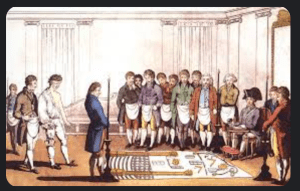 IN THE BEGINNING
 Fifteen years later, the first (and only successful) Crusade to seize Jerusalem was launched. At the conclusion, the world’s most influential secret society was born: the Poor Fellow Soldiers of Christ and the Temple of Solomon, otherwise known as the Templars. Only men 21 years or older could receive the highly secret initiations. Although sworn to poverty and celibacy, they organized an international banking system and became among the richest men in the world, building and maintaining an elaborate network of castles throughout Europe. The Holy Roman Empire had forbidden loans at more than minimal interest, but the Templars created loopholes in these rules and employed them to become the bankers of Europe, with the power to create war and fund Crusades. For 194 years they dominated trade between East and West.
 Eventually, after the King of France became deeply indebted to the Templars, and feared they were planning to create their own kingdom in Southern France, he managed to move the Vatican to France after installing his puppet as Pope. In 1306, Pope Clement V requested a conference with Grand Master Jacques de Molay as a means of luring him into a trap. On October 13, 1307, when de Molay appeared in France, all known Templars were ordered arrested and subjected to torture, whereupon many confessed to the crimes of homosexuality and devil worship. Five years later the Pope outlawed the Templars and seized their assets. After nearly seven years of torture and imprisonment, de Molay was burned at the stake on March 18, 1314. As legend goes, an armada of Templar boats filled with gold managed to escape to Scotland, where they found refuge with the enemies of the King of France. They allegedly were instrumental in helping Scotland win its independence from Britain in 1327, through their financial support of Robert the Bruce. According to Masonic lore it was during this period that the Templars created Freemasonry as a secret society, with special handshakes and codes of identification—a society that would remain completely underground for nearly 400 years, until its public emergence in 1717.
 HELL FIRE
 REVOLUTION AND ROTHSCHILDS
 The Rothschilds have also been suspected of funding the Illuminati, perhaps the most notorious Masonic-style organization, founded in Germany by Adam Weishaupt, a Jesuit-trained lawyer and expert in Catholic law who had also been initiated into the Rosicrucian Brotherhood and Freemasonry. After Martin Luther’s Reformation shook the foundations of Catholicism, seven Spanish knights responded by creating the Society of Jesus (Jesuits), whose primary job was to roll back the Reformation. This operation was realized largely through the creation of universities throughout Europe, schools that undoubtedly became breeding grounds for Jesuit attempts to undermine Masonry from within. No one can be certain whether Weishaupt was a Jesuit secret agent or a real revolutionary, but it seems far more likely the former was true. In fact, many Masons of the time often wondered if their lodges had fallen prey to Jesuit conspiratorial control. The Jesuits grew fantastically rich and powerful by dominating trade with the New World, so much so that a movement circulated in Europe to petition the Pope to dissolve the order.
 Aside from the Jesuits, the Vatican had a military order under its command, known as the Hospitaller of St. John of Jerusalem. Naturally, this order traced its origins to an earlier date than the Templars. They became known as the Knights of Rhodes in 1309 and have been called the Knights of Malta since 1530, according to their Website smom.org. However, the Malta Knights split into many Masonic-style organizations over the years, most of which were never recognized by the Vatican. The most infamous lodge was created after Napoleon invaded Malta. This order sought refuge in Russia and later, after the Russian Revolution, in Pennsylvania. Although branded as a “false order” by the Pope, the Shickshinny Knights of Malta of Pennsylvania are legendary for their far-right political activities, as well as for having British and Russian nobility in their membership.
 Weishaupt was one of the only secret society leaders convicted of plotting world domination, in a trial that created reverberations in Masonic lodges around the world. A Bavarian court outlawed the Illuminati (and all other secret societies) several times, but historians believe the highly publicized cases only drove the organization deeper underground. Today, many researchers understand the importance of Freemasonry in the American Revolution. The Boston Tea Party was organized out of St. Andrew’s Lodge, of which John Hancock and Paul Revere were prominent members. Hancock was a smuggler who rose to become the richest man in the Colonies. He was a primary instigator of the Revolution and author of the Declaration of Independence, something reflected in the size of his signature on the document. Revere became Grand Master of Massachusetts. George Washington was Grand Master of Virginia, and 33 of his generals were members of the secret society, as were the two most prominent nobles arriving from Europe to support the Revolution, Marquis de Lafayette and Baron von Steuben. Technically, any rebel lodges separated from the Grand Lodge during the war but were reinstated to British Freemasonry after the conflict was settled. Many lodges remained loyal and sheltered Tories. In New York City, the richest Tories moved their assets into Trinity Church to protect them from confiscation.
 MASONS AND MORMONS
 On September 22, 1827, Freemason Joseph Smith claimed to have been visited by an angel named Moroni, who directed him to uncover some golden tablets buried near Palmyra, NY. These tablets became the basis for the Mormon religion. Due to hostility to both Masonry and Mormonism, Smith was forced to move his lodges west, first to Ohio, then to Nauvoo, IL. The story took an even stranger twist when William Morgan’s widow Lucinda, married Freemason George W. Harris on November 23, 1830, which just happened to be the same year Smith founded the Mormon Church in a nearby New York town. The couple moved to Nauvoo and converted to Mormonism, leaving some to wonder if the entire Morgan affair had not been stage-managed for some hidden purpose.
 SKULL AND BONES
 SCANDAL IN ITALY
 PEDOPHILE PRIESTS AND MIND CONTROL
 Today most researchers on the JFK assassination agree that Lee Harvey Oswald was a real Manchurian Candidate, first subjected to mind control in 1955 when he entered the Louisiana Civil Air Patrol at age fifteen and fell under the command of hypnotist

 An astonished Laurain Moulin watched her cat suddenly go into convulsions and keel over dead in the kitchen. Moulin opened the door to the barnyard and saw several ducks staggering by, while others marched in unison, acting more like penguins. One duck was lying dead on the ground.
 Wide-eyed and babbling, townspeople began appearing on street corners at all hours, some acting paranoid, others wearing beatific smiles and speaking of universal love; still others were dizzy, confused and had trouble executing the simplest chores. A few were hallucinating so wildly that they could barely distinguish fantasy from reality. An ambulance was called for an elderly man named Felix Mison, who seemed on the verge of a heart attack.
 Ergot is a parasitic mold that can form on rye, wheat and other cereal grains in high humidity. During the Middle Ages, epidemics of ergotism had appeared sporadically in Europe, usually after heavy rains during the harvest season. Symptoms included convulsions, seizures, nausea and vomiting. Many of the afflicted also experienced strange hallucinations, and their fingers and toes became gangrenous. The disease became known as “St. Anthony’s fire,” named after the order of the Roman Catholic monks who became famous for treating the illness (although treatment consisted of little more than putting patients in a hospital filled with religious icons). In 1650, a fungus was first suspected as the cause of the epidemics, but it wasn’t until 1676 that the first mention of ergot appears in the English language. The most severe outbreaks took place in Gatinais in 1694 and Wurttemberg in 1735, although today some researchers believe that the Salem witch trials of 1692 were also the result of ergot poisoning.
 Unfortunately, the police responded with the worst possible tactic: tackling and restraining the delusional people and forcing them into overflowing barns and other makeshift hospitals that were being set up all around town to isolate the sick. At times, it took a dozen men to capture and subdue a single person. The following day, reinforcements arrived in the form of the militia, armed with more ambulances and more straitjackets. It was decided to move the delusional people into secure asylums, a strategy that merely amplified their desire to escape, while isolating them from the comfort of their familiar surroundings. Those who resisted violently were given electroshock therapy at the asylums, increasing their pain and confusion.
 But when an orderly came back to check on him, Emile had somehow eaten through the leather straps (breaking many of his teeth in the process) and was bending the iron bars in the window so he could escape. Six orderlies were needed to move him to a subterranean room with no windows. By now, two other men had died, along with a woman who suffered from hyperthyroidism. The woman reportedly showed the early signs of gangrene on some of her toes, an almost certain indicator of ergot poisoning. Depending on whose statistics you trust, between five and seven people (most of them elderly and frail) would eventually die from the mysterious illness.


 In 1968, John G. Fuller published a book titled The Day of St. Anthony’s Fire (Macmillan). He focused exclusively on Briand’s bread as the cause of the outbreak, dismissing other theories that the townspeople put forward (including the possibility of a chemical-warfare experiment). However, today many researchers will be inclined to look at Fuller as a person of interest in a possible coverup. Immediately prior to his book on Pont-Saint-Esprit, Fuller had published an account of Barney and Betty Hill, the first recorded case of alien abduction, an incident that allegedly took place as the New Hampshire couple returned from a vacation trip to Canada in the early 1960s. Many researchers have come to the conclusion that thousands of Americans were secretly hypnotized and dosed with LSD in the 1950s and early 60s as part of the CIA’s mind-control experiments, and the Hills may have been two such victims. According to this scenario, the alien-abduction story was planted through hypnosis to mask the activities of government scientists. The current alien-abduction mythology may, in fact, be largely an invention of the national security system as a cover, which might explain why UFO documentaries and features are so prevalent in the media, while investigations into the deep state exceedingly rare.

 In 2008, the events of Pont-Saint-Esprit were further investigated by Steven K. Kaplan, a professor of European history at Cornell University and an internationally recognized authority on French bread. Although it was written entirely in French, Kaplan’s Le Pain Maudit was the subject of a feature in the New York Times. Kaplan went to Pont-Saint-Esprit after the book was published to give a talk about the incident. Although 30 chairs were set up for his appearance, over 400 people attended, demonstrating that the town had not forgotten the experience. According to the Times, “The government did its best to smooth over the incident and after many inquiries and court cases the affair was finally dropped in 1978. Explanations abound, none of which Kaplan finds satisfying. The most popular one, poisoning by a form of ergot fungus, he finds unconvincing. Mercury poisoning caused by Panogen, a cleansing agent used in wheat containers, was disproved although Kaplan says the government used it as a coverup.”


 It would take two agonizing hours to arrange a cease fire, and it happened only after ATF agents ran out of bullets. During that time, six residents were killed and four were wounded, while four ATF agents were killed and sixteen wounded. Many of the wounded agents were lying helpless on the field of battle. Of all the residents, Koresh was the most seriously wounded, a bullet had blown through his side. News photos reveal ATF agents in panic and disarray, loading their wounded on the hoods of vehicles.
 The ATF had arrived in overwhelming force, including air support, and assaulted a church, only to be driven back by less than a dozen armed men and at least one woman shooting back. Suddenly, instead of a ZBO, ATF had one of the biggest pubic relations disasters in American history in the making. The ATF agents were quickly replaced by the FBI, the media were drawn back a mile from the scene and all lines of communication to Mount Carmel were severed. “A crazy cult is holding their children hostage,” went the standard press release.
 The most damaging “evidence” of what really happened that day is the bizarre disappearance of all videotape shot by the ATF. The explanation given was that all cameras malfunctioned simultaneously, producing no tapes whatsoever. It’s far more likely the tapes disappeared because they supported the claim of Mount Carmel residents, all of whom insisted the ATF fired first.
 Today, the ATF tells a much different story: “We were ambushed by a hail of machine gun fire the moment we got off the cattle cars.” This explanation doesn’t hold up. Photos reveal Mount Carmel heavily peppered with bullet holes, while the vehicles used as cover by the ATF bear few signs of incoming fire.
 The Siege
 Early on, Koresh agreed to voluntarily surrender if a one-hour tape explaining his theology was aired on national radio. However, the night before, the residents had dug out the medicinal whiskey supply and held a party in the chapel while he lay wounded upstairs. Koresh abruptly canceled the surrender by saying God had told him to wait. “Some of us blamed the previous night’s binge, saying we’d sinned and acted wildly,” writes Thibodeau.
 The FBI responded angrily and began a psychological war, playing loud music and the sounds of animals being tortured. Searchlights beamed into the building during the night. “Every time we thought we were cooperating, people were coming out, or we were doing what they asked, we’d be punished, almost right after complying,” says Clive Doyle, one of the survivors. “The electricity being cut off, the music being played, all that kind of stuff just gave us the attitude they certainly did not mean what they were promising, that we couldn’t trust them. All the things that went on for the next fifty-odd days just confirmed in our minds they had no concern for our children at all.”
 “By noon the building is a tinderbox,” writes Thibodeau. “A thick layer of methylene chloride dust deposited by the CS gas coats the walls, floors, and ceilings, mingling with kerosene and propane vapors from our spilled lanterns and crushed heaters. To make things worse, a brisk, thirty-knot Texas wind whips through the holes ripped in the building like a potbellied stove with its damper flung open.”
 Fire trucks were available to put out the blaze, but were held back and not allowed near the scene until nothing but ashes were left. Meanwhile, the tanks ran over bodies and pushed debris into the fire to make sure nothing remained standing. Texas Rangers, who were not allowed near the scene until much later in the day, believed the FBI was salting phony evidence, while destroying the crime scene to make an investigation impossible. What little evidence did remain disappeared quickly.
 After the smoke and dust cleared, the ATF flag was run up the Mount Carmel flagpole, signaling victory. Only the bunker where the moms and kids roasted alive (or were poisoned by gas) was left standing. Meanwhile, the official press release went out and the official story became: “The cult set fire to the building and committed mass suicide rather than surrender.” It was spun in the media as a Jim Jones-style event.
 One third of the Alfred E. Murrah building was destroyed and 168 were killed, including 19 children and two pregnant women. Most victims were crushed by falling debris. Thus the legacy of Ruby Ridge and Waco was captured through the greatest act of domestic terrorism on American soil, an event that shocked America and took most of the wind out of the sails of a growing militia movement. In other words, this event had the opposite effect of the FBI’s burning of Mount Carmel.

 Strassmir, meanwhile, immediately fled back to safety in Germany after the bombing and remained hidden from public view while McVeigh was executed on June 11, 2001. McVeigh could have been a spook working some deep-cover assignment involving hypnosis as well as wearing a biometric chip who got played like Oswald. He was so cool at his execution, I had to wonder if he was convinced the execution was going to be faked and he should act dead for the press until they were ready to relocate him into witness protection.
